Friday, April 30, 2010

ARCTIC CUTS

Those who understand the Arctic, experience a radical thing: a cut into halves of one's being. If you are accustomed to staying mentally vigilant, you notice that this vigilance gets heightened by the physical conditions of the place: there is something in the air and in the light that heightens your mental senses. But in the Arctic you are also vulnerable. This means that if you go around talking to stones, and asking them to talk back, you may well induce yourself into believing that the next thing that could happen could also be a literal stoning, rather than an echo. You can get hit by one with sharp edges that splits your core into more cuts. Of course, your vigilant state of mind helps you see beyond the act, and as ever conclude that if the agents involved in stoning are people, rather than natural forces, then their motives are either manifestations of self-sacrifice, sacrificing time, or the occasion. Some would valorize stoning positively: clean hits can be so pragmatic sometimes, but the ones who know better, know better.

There is no such thing as clean cuts. Rather, what one experiences is in fact merely a fallacy of discontinuity. Those who know this get on with the program and the continuity. This can have various forms of manifestation, all according to what 'the meanwhile' allows for, that is, the moment when going from vigilance to vulnerability is paved with stepping on uneven stones, which means that if you want to survive you have to start flying. But then flying has always been my specialty. I can fly so high that there is simply no goddamn thing that can touch me. Here in Tromsø, I did manage to get on with my program, in spite of cuts and hits, and being crushed by the sublime and having to ask why, and really all the time. All these speculations. You fly over them. Sticking to knowing what you know inspires.

Even before I put the full stop on my almost complete manuscript on epistemologies of creative writing, I found myself writing vigorously on my next project. This one should please my sister a great deal, as she has been anticipating it for years now. As with my writing practice, it always begins with a title. So, here's the new one: Stone, Speak: Stone Games in Motion in Wittgenstein and Gertrude Stein. I got this idea while retracing my steps today on the walking trails that I've been using every day for the past month. I filled my pockets with hibernating stones from under the snow. I wanted to feel them on the plane back home. I wanted them to echo back: I have Norway's power, the power of the Arctic light, and the power of my trust in myself. The third one implies, of course, the idea of eternal return to Norway, forever and ever. I always did like infinities. They are ever so simple. So, why not, indeed, write something on substitutions, replacements, shifts, recursive structures, and intelligent dialogues against the background of the continuum? While objects of desire may be replaced and substituted, the continuum is not. Once the presence of that is affirmed, trust goes up in value. Wittgenstein is right to suggest that when trust is powerful, it costs more: “Look at a stone and imagine it having sensations.” Wittgenstein always rhetorically asks in his Investigations, can one say, can one trust oneself to say... Yes one can, Gertrude Stein answers, in Sentences: “Cesar Onestone, Mr. Einesteine.” Where cuts are concerned, everything should be mentioned at least twice and in at least two contexts, except the cutting one. In the Arctic, everybody flies: yourself, your shadow, your signs, and your stones.


Sunday, April 25, 2010

AND YET

466. Thus it seems to me that I have known something the whole time, and yet there is no meaning in saying so, in uttering this truth.

467. I am sitting with a philosopher in the garden; he says again and again and again, “I know that that's a tree”, pointing to a tree that is near us. Someone else arrives and hears this, and I tell him: “this fellow isn't insane. We are only doing philosophy”.

(Ludwig Josef Johann Wittgenstein & Gertrude Elizabeth Margaret Anscombe: On Certainty)

Saturday, April 24, 2010

PANORAMICS

Today my sister called me to ask me when I'd come home. She misses me, she claimed. I blurted at her and called her crazy. I said, “are you crazy, what makes you think that I want to come home, ever?” “You're crazy,” she retorted. And I said: "you don't know what crazy is until you fall in love with Norway.” “But don't worry,” I continued, “I'm not crazy enough to stay here and be poor.” So I'll be back on the job on the first, to my infinite regret.

While shooting ducks outside the place I'm staying at, on top of a mountain in Tromsø, of course, it occurred to me that there is a peculiar depth to Norway that fascinates me. It's Norway's profound voice that attracts me. Wherever I turn my head, I hear an echo: “speak to me.” This is me talking to the stones, the snow, the void, and the trees. And they echo my sounds, though when my voice filters through snow, it sounds like snow. The same with the void. After walking on the panoramic plateau and reflecting myself in the beautiful waters around today, I marveled at how articulate Norway makes me feel. And I also thought that I looked like a woman in one of Eric Rohmer's movies.

A Tale of Winter is a favorite, and at some point one of the characters says to the protagonist: “You're articulate, because you let your feelings talk.” The lead is a woman who accidentally gave the love of her life a wrong address instead of her own after one encounter. The man is thus lost to her, and yet she keeps waiting. But while she invests her waiting with faith that the man will find her, she also lets herself be courted by two other. They 'speak to her', as it were, even beyond the philosophical babble which informs all of Rohmer's works, but they don't seem to echo her desires properly, which has consequences for her indecision to love either of them. Rohmer's film is filtered through Shakespeare's Winter's Tale, which is very much about desires, resurrecting statues, and making the stone speak, and it struck me that what makes Rohmer's language so powerful is the fact that he dares to say to Shakespeare what I say to Norway: “speak to me.” Indeed, eloquence emerges from faith in the fact that what will be echoed back will not be a standard answer, but rather faith itself in the cold.


Thursday, April 22, 2010

WORDS

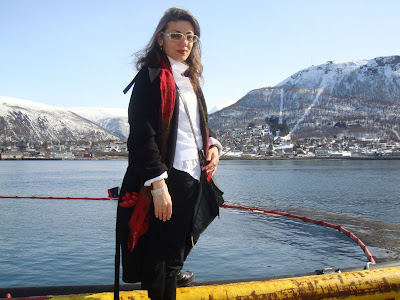
Today I dressed up. Black and white and red. I was getting ready for the Stendahl syndrome. I was going to be a ravished woman. Norway was going to ravish me. I was heading for the Lyngen Alps. Well, this miraculous mountain range in the Arctic is basically right outside Tromsø, but you can go all the way up to Alta through it. I didn't, even though I was tempted. I combined riding the bus with sailing instead. The Norwegians were yakking, while my heart kept rising. By the time it got to the throat, the breath was cut, and the only murmur I could utter, intoning to the Norwegian sound, was Norge min. My gut wanted to compensate for the lack of air and astonished muteness, but it was also hit hard. It was bleeding blood and snow. Bachelard's simplified cosmos—and mine—was doing its thing, which is to be vast and simple at the same time. Between the ohs, and the ahs, and Oh my God, and shut the fuck up, I was clasping my Tromsonian heart. It contains my mantra when here: skal ikke, it's written on it. I will not. I will not. I will not leave this place. I tell myself this every time. However, today, at the end of the day, I was disappointed in myself. I didn't think that I deserved to stay. Instead of allowing the sublime to humiliate me, crush me, and send me some place dying, I went rational and arrogant. Yes, I decided. The day I'll be able to afford it, I was going to buy the whole Lyngen fleet. And then, ban the yakking, ban the TV yakking, ban the bad musical lyrics yakking. Ban the bloody yakking. The only yakking I would allow, if I should ever want to transgress my own rules, would be in the bar in the company of Glenn Gould explaining, and then demonstrating, why he did this or that to his Bach recordings. That's it.

In other words, when we don't go with the sublime, we are into rescuing the world from its morbid fear of silence. Some irony. In the simplified cosmos, simplicity itself is but a shadow of itself. This side of whiteness and winter, we create narratives: there's a mountain here, and a sign there. Bathsheba was bathing on the roof when David saw her, and then it went as it did. And Solomon was chasing the goats up the hills with his head burning, while the Queen of Sheba was touching her small breasts, ever so passionately. And so on. Before my departure, I was wondering why the majestic V, carved into the mountain, insisted on washing its legs in the sun. What could that mean? What could that mean? Oh, Christ, give me a Norwegian to ask his opinion. The blue sky is turning whitish pinkish yellowish. I'm still not in bed, and yet I'm afraid that the dawn is here already, catching me yakking. We are all doomed to fail words and their shadows.


Tuesday, April 20, 2010

NORDLYS

Fra det høye Nord: gratulerer med dagen, vennen min, som nordmennende ville sige. En ur norsk jente som meg ville hilse med dette: velsignet være deg, som jo er noget andet. Der er lys i mine ønsker:

“Jeg vil plante et lyn i klippen
og fastholde meg selv og alt i et syn,
min hånd skal rører ved all skjønnhet
og forme den til et vern mot tiden...”

--- Peter R. Holm, Stentid (1962)

Kanskje vi får til en liten kafferast i Tromsø igen.

Hejdå, skål, og god fødselsdag.

Friday, April 16, 2010

MERCY

In his short essay, “Two Forms of Mute Speech”, from The Aesthetic Unconscious, Jacques Rancière has this to say: “The silent revolution that we have called aesthetic opens the space in which an idea of thought and a corresponding idea of writing can be elaborated. This idea of thought rests upon a fundamental affirmation: there is thought that does not think, thought at work not only in the foreign element of non-thought but in the very form of non-thought. Conversely there is non-thought that inhabits thought and gives it a power all its own. This non-thought is not simply a form of absence of thought, it is an efficacious presence of its opposite. From whichever side we approach the equation, the identity of thought and non-thought is the source of a distinctive power [...] In opposition to this living speech that provided the representative order with its norm, writing is the mode of speech that keeps silent at the same time, that both knows and does not know what it is saying. But there are two major figures of this contradictory mode, corresponding to the two opposite forms of the relation between thought and non-thought [...] Mute writing in the first sense is the speech borne by mute things themselves. It is the capability of signification that is inscribed upon their very body, summarized by the “everything speaks” of Novalis, the poet-mineralogist. Everything is trace, vestige or fossil. Every sensible form, beginning from the stone or the shell, tells a story. In their striations and ridges they all bear the traces of their history and the mark of their destination [...] The second form of mute speech is likewise at work here [the work of logos and pathos in literature, CE]. In place of the hieroglyph inscribed on the body and subject to deciphering we encounter speech as soliloquy, speaking to no one and saying nothing but the impersonal and unconscious conditions of speech itself” 31-39).

Today I was thinking that Rancière may be a latter day Wittgenstein, apart from myself, of course, and who, although speaking of the significance of Freud's theories today, can be said to elaborate in fact on the controversial Wittgensteinian statement: “Whereof one cannot speak, thereof one must be silent.” The premise for Wittgenstein's formulation, and which has baffled philosophers ever since, in my opinion is precisely this one: “everything speaks.” Only in this light can we understand what Wittgenstein also means when he says that all his writing is meaningless. It is meaningless in the sense that it always relies on a form of mercy, being at the mercy of interpreters. So, it comes down to an interpreter's ability to match both the thought and non-thought in Wittgenstein, the “everything speaks” already, if Rancière's “power” is to be enforced. The subtler implication of such an ability is this: insofar as one has the power to raise himself above meaningless discourse, one also has the power to descend to the lowest level of signification when signification is precisely least signifying. This means that one goes down on one's knees, and instead of stretching an arm, saying, here's a writing tool that will get you out of the gutter, use my hand—one says instead, I have mercy. I give you not writing, but the mute speech of my presence, right down there with you. This descent is the cost of power. Power over the silence that signifies nothing and everything at the same time. With this power comes the obligation to answer to the ethical call: “do not remain silent.” Why? Because mercy must be shown when total surrender has been proven. Mercy for two, oneself and the other, both forms of mute speech, the “everything speaks” and the silent story of “I love you.”

Saturday, April 3, 2010

DOGS

How baffling these questions are, questions on which one would prefer not to touch – I understand that standpoint too, even better than my own – and yet questions to which I completely capitulated. Why do I not do as the others: live in harmony with my people and accept in silence whatever disturbs the harmony?" (Franz Kafka: Investigations of a Dog)

There are three things: Seeing yourself as something alien, forgetting the sight, and remembering the gaze. Or only two, since the second contains the third." (Kafka: Blue Octavo Notebooks)

The right perception of any matter and a misunderstanding of the same matter do not wholly exclude each other." (Kafka: The Trial)


Thursday, April 1, 2010

RESURRECTION

I'm good at creating traditions even though I myself am not traditional. I'm back in the Arctic for a whole month – or more, should I decide to go native with the light. So what the heck, I go see my lover again, Roald, who is always waiting. I ask him what the word is for the day. “Adventure is bad planning,” he tells me. This is good news if you have good sense of humor. It's bad news if you're serious. ——Everything is closed for the Easter. Even the traffic. The smart Norwegians are out in the wilderness. The not so smart ones are probably in Rome. After meeting the wolves tomorrow, I'm ready for the Arctic cathedral: The Easter midnight mass. Even though it occurs to me that people like us, who are in love with the Arctic, need neither belief nor religion. In the Arctic you are a nihilist. This is good news if you're an existentialist as well. It's not so good if you're not. ——The light up here, you just die. The smell, you die twice over. Jesus died once and he got resurrected once. The Arctic lovers die every day and get resurrected by snow crystals. Every day. ——Lively Easter to you all.