Come Fairies, take me out of this dull world, for I would ride with you upon the wind and dance upon the mountains like a flame!
--William Butler Yeats
That's how it is on this bitch of an earth.
--Samuel Beckett
Everything popular is wrong.
--Oscar Wilde
He found in the world without as actual what was in his world within as possible.
--James Joyce
It is clear enough that you are making some distinction in what you said, that there is some nicety of terminology in your words. I can't quite follow you.
--Flann O'Brien 


"If I were asked which of all the mysteries will forever remain impenetrable I would not hesitate to answer: the obvious." - (Edmond Jabès: The Book of Shares)
Monday, March 29, 2010
DUBLINERS
Sunday, March 28, 2010
42
For Richard Ellis
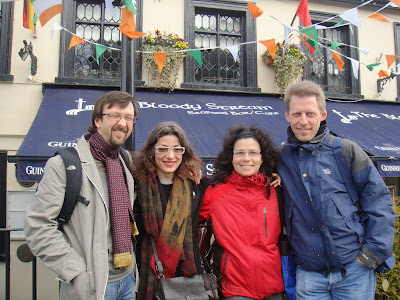
Between numbers and aging we talk about reduced circumstances. “I'm dangerous right now,” he says. “Oh really?,” I reply. “And stop calling me Richard,” he says. “Only mother does that.” “Richard,” I say, “I love being men's mother.” “Nooooo,” he says. “Yeeeees,” I say. “Everybody loves their mother, and I want to be loved. Forever and ever.” “You know what your problem is?” he asks. “Give me the word,” I excitedly say. “Energy.” “Nooooo” I say. “Really?” pretending that this is the first time I'm hearing about it. “And why is that a problem?” I say. “Because it's too precisely calibrated,” he says. “Yes,” I say. “42, that's the word”. And then it hits me. “Fuck me, I'll be 42 in 7 months, and some days, and some hours, and some minutes – I'm not good at counting, and arithmetics only gives me a headache.” “Fuck indeed," he says. “Drink your Guinness, then. Empty it. The glass.” And I'm thinking: In The book of Kells, it is written: The polar bear with pink wings will go for blood meridian. “At the pub with the bloody feminists, you have to argue about literature. And your arguments have to be good. Really good.” “Richard,” I say, “I'm going to the bathroom before you piss me off.” “Yes, yes, yes,” he says. Molly said that too. Yes, I'm in the middle of being fucked by 42. So it goes with men and their mothers. Clever men and their mothers.
———
PS: Richard, next time I see you, I'll have a silk tie for you. Silk, you hear me?
PPS: The paper, on aging, Eccentricity Galore, no problem friends, here it is. Don't get too depressed.


Tuesday, March 23, 2010
FOLKLORE
I'm writing a paper on aging for a conference in Dublin this Saturday, but my head is set on disappearing in the eternal snow of the Arctic on the last day of this month. What keeps me going is the idea of oysters that my friends in Dublin will make sure I get enough of. This keeps my head away from cooling down entirely and untimely, which makes my writing retain a sense of decency against the background of some outrageous claims I venture to make; not uplifting, not optimistic, and definitely not hopeful. Perhaps I'm contaminated by the short story “The Day Before the Revolution” by a favorite writer of SF and fantasy fiction Ursula K. Le Guin, who has this to say about her protagonist, an old woman who started a movement in her youth, and whose aim was the eradication of governments and nations, but who is now to die on the day before the event proper happens: “After a lifetime of living on hope because there is nothing but hope, one loses the taste for victory. A real sense of triumph must be preceded by real despair.” I'll spare you of my analysis, which in the academic context is not so bad—in terms of originality, impact, virility, and visibility—but there is something else that makes me think of what remains in the face of resignation. Perhaps I'm contaminated by the film Harold and Maude, which I juxtapose with Le Guin's take on anarchist women. Whereas Odo, Le Guin's protagonist doesn't lose hope but the faith that 'her' revolution will make any difference to her in the final analysis, Maude loses faith, but not the hope that at least her lessons in, what she calls, “odorifics” will make a difference. This makes me think of the passion we experience every time we encounter beauty. Most artists believe that beauty is the greatest mystery in life, and because a mystery, it can only be experienced in the mind. So, when everything is said and done, if there was beauty in it, then beauty prevails. Not the context. Not the text. This is a beautiful thought in itself, and it makes me feel good even in the face of thinking about the cruelty of loss: there's loss everywhere, even when you give nothing of yourself. Perhaps I'm contaminated by the greatest singer of all times of Romanian folklore, Maria Tanase, whose song, “Cine iubeste si lasa” [whoever loves and leaves the lover] sends shivers down my spine, as I write this, and as I think about eccentric old women. Whoever listens to Tanase—who died untimely of cancer in '63 after a life of great success, and who, after a period of having been banned from performing in public, sang in Paris and New York—is bound to be touched. Although the song is all about cursing, one gets the sense that because of the lamenting tone that cuts through you, the beauty of the sound transcends the prophetic proclamations, and it thus undoes the word. Beauty is as beauty does. It makes us all age with grace.
Sunday, March 21, 2010
BACH'S LESSON
Bach's lesson: there's no such thing as detachment. Only attachment to other keys. Hitting the right ones at the right time touches.
Friday, March 19, 2010
TOP 3
- Norway: the supreme “it” (Norway is Norway, as you out there, who read this faithfully, already know).
- Finland: the almost “it” (as a refugee, 20 years ago I ended up in DK, even though I came to Scandinavia on a false visum to Finland. Goddamn the Geneva convention. They stopped me at the gate to Helsinki).
- Denmark: the “it” that enabled the discovery of the supreme “it” and the eternal return to Finland - almost making “it” – I now take short trips to Finland some 5 times a year, which means that I can't say a single bad word about Denmark, a country that educates me, hosts me, and employs me well enough to be able to afford both Norway and Finland, even though, in truth, everyday I think of ditching the good will of good Danish people, sell everything and buy a hut à la Wittgenstein in Norway and move there for good – well, perhaps a hut with slightly better amenities (I'm at the point in my life where, after having received some and having given some back, I'm tired).
A flash of emotion connected to the 1,2,3s above went through me today on the plane back from Finland, where I indulged in my pet projects that I do con amore and that only the initiated ones know about – I mean, I discovered that I didn't have a problem rising to the task of delivering a “very very inspiring and clever paper,” as several people had it, and answering the expectation that I be a bona fide Nietzsche expert – which I'm not – rather, an impostor, but then again, you can always fool people especially if you've read everything that's relevant to read.


Sunday, March 14, 2010
WAVELENGTH
My nephew asks me: “what are you thinking about?” I reply: “Love as a straightforward thing.” “Do you believe in that?” he wants to know. “Nietzsche does,” I say. Then he goes: “Bach is straightforward, Norway is straightforward, and my mother is straightforward.” Enjoy your Sunday, and your kids – if you have any.

Friday, March 12, 2010
FUCK 'EM ALL
I'm worried that my friend, the genius mathematician – yes, yes, I insist on the genius part, for obvious reasons – is going political. I mean, I have nothing against politicians as politicians – they are in the business of discourse, and they do nothing but deliver statements that appeal to loads of emotion and nothing else; that's the function of political discourse – but I'm worried about intellectuals as politicians. An intellectual as politician is simply an impossibility. By definition, if you're an intellectual, your business is to think and produce a discourse that reflects thinking and nothing else, so it surprises me a great deal when I hear that intellectuals, now and then, have designs on political life: for, also by definition, if you're an intellectual, you are not in the business of pleasing the masses. And if you don't please the masses, what's the outcome? Well, it ain't rocket science: as you become unpopular so fast, you'll be taken down even before your goddamned political career takes off.
Now, the mathematician, who is a first caliber writer of not only numbers, but other things that particularly amuse me a great deal, is contemplating doing something drastic after the latest Romanian situation in DK, like, leave the country or going into politics, which means that he will deprive me of his genius thoughts. And we can't have that. Period. Here's the situation: some disturbed bozo, who after his release from prison in Romania, hit Denmark, killed a Norwegian stewardess, and then off he went downstairs at the Radisson Hotel to gamble a bit on her credit cards. Upon his return, and realizing that his face was recorded on some camera, he decided to give himself up. The police officer, chief of the investigation, made this statement to the press, upon closing the case without fussing: “well, of course, Romanians are like this, they'll kill you for 200 kr; they're all brutal.” My friend has been feeling crushed, and hit in his Romanianness ever since to such an extent that, now, instead of writing some things that won't make me worry, is counting how many years, days and nights, hours and minutes he has been in Denmark, without any chance of real recognition – he feels brutal, as established – and what all that time is worth in terms of assessing wasted time, future time, and remaining time, before the time comes to hit the heavenly paradise. I find myself seconding opinions of the following kind from fellow-Romanians, as to what the best strategy is. One of them wrote on Herr Lektor's blog: “nothing can can take away what you can, stand tall, fuck 'em all”. Amen, I said: fuck 'em all.
On a more general level, I felt ashamed to admit that nothing has changed for me since I hit Denmark 20 years ago, which is 11 years and 8 months longer than my friend's permission to stay here. I still want to say what I wanted to say then, upon realizing that, hey, as you're not French, or something more cultured, there's no way in hell anyone is going to give a damn on what you can or cannot do. So, if you want to make it in Denmark, the best strategy is to ignore the schmucks (now, also generally I actually wonder whether ignoring people, popularly speaking, is the result of your thinking that they really are schmucks, but we'll leave that thinking to those in businesses other than politics).
Turning to feminism helped me a little, as with Gloria Steinem: “power, if you want it, grab it, woman, don't wait for them to give it to you.” That's right. I did what I could. While getting myself an education I started telling regular Danes that I came from New Zealand. I always relished their reaction, which was completely blank, and devoid of stereotypical images. “New Zealand, oh, how interesting, good for you,” they'd say. If there was any reaction, yet adding to the general ignorance, then it was this kind that completely bypassed orphans, gipsies, pickpocketers, criminals, and other fuckers: “New Zealand, there are a lot of sheep there.” To this, while thinking, “tell me something I don't know,” I would politely say, “yep, you bet your ass.” So, what's there to say, Herr Lektor, your lektorship, if you can't take it any longer, before you go into politics, you might want to visit New Zealand. There are a lot of sheep there. Exercise your politics on them. You won't come out as either naive, avid for power, or some other, ultimately rather uninteresting and sheepish altruism that's impossible to achieve i dagens Danmark. The sheep will be the only kind that will allow you to keep your intellectual integrity as you'll go bleating with them through the fields. Beeeh.
Tuesday, March 9, 2010
SONG OF SELF
Going through Nietzsche, again, a thought struck me today: as much as Nietzsche relished bashing literalism, he himself wanted to be taken literally. In the songs of Zarathustra, after he goes from 1 to 12 on the depth of eternity – and woe to all those who don't take Zarathustra literally – he sings “the 7 seals or the yes and amen song.” I read what Zarathustra has to say literally simply because he makes sure not to have any nuance between his yes and his amen. Thus each seal ends appropriately with a desire for eternal recurrence and 7 repetitions of these lines: “Never yet have I found the woman from whom I wanted children, unless it be this woman whom I love: for I love you, O eternity! For I love you, O eternity.” While getting dressed to go to the hair-dresser's, I found myself chanting back: O Zarathustra, there's never any “us,” is there? Only eternity, the pure, formal, non-nuanced eternity. Or what, O Zarathustra? For why am I wearing my Rick Owens Lilies smash of a dress? Only so that I can fall in love with myself? Recurrence exists. I've decided to reproduce myself, my yes and amen, as I walk the tightrope of bonds, ropes, and seals and pledging to understand the meaning of “there is no us,” on my way to Finland, to talk about Nietzsche, and how he would have loved me more than he loved eternity, if he saw me the moment I walked in on him while he was praying with a whip in his hand, and love in his eyes. Eyes which said: light grey is definitely my favorite color.
Saturday, March 6, 2010
MAN ON WIRE
For Philippe Petit
“My life is boring,” you shout. “Boooooring!” “Sure it is,” I say. “Judging by the way your arms stretch over your empty desk, head banging against it, your boredom measures exactly 220 cm. That's bad. What do you want?” “I want her, the woman on wire,” you say, sobbing. “Everyday she balances on the rope that's rigged between her two balconies through her goddamn living room that it drives me crazy to know just how she does it. She always acts on her gut feeling, but only with view to making monstrously rational analyses of everything. Goddamn everything.” “Are you saying balconies? Like in that Romeo&Juliet thing of a tragi-comic-romantic play, written by that queer guy? Well, go ask him, then. He'll tell you: these days, it ain't about climbing ropes up the balconies or hair strands. It's all about descending. From a balloon. A red balloon. It's in the swing. Vroom, in through the glass door, landing straight onto her goddamn wire, leaving the silk behind, gliding straight between her legs, leaving her astonished. It's all about physics, man, and numbers! The whole of 220. Two plus two is four, and if you add the zero on top, now there is a number, glissando, and gaussian, the whole four-point formula for functions, the law of magnetism kissed on its legs.” “Oh, you're here,” she'll say. “Good, let's fill this desk with a lot of clutter, and chatter, and chiming glasses of wine. We'll have Gauss wrap the balloon and tie the rope.” Today boredom vanishes as we smell the gunpowder on our hands.
(Note: in 1968, when Philippe Petit got the idea to walk the tightrope between the, then as yet unbuilt, Twin Towers, this is what he said: “it's not about conquering the universe, but, as a poet, about conquering beautiful stages.”)
Thursday, March 4, 2010
MASS
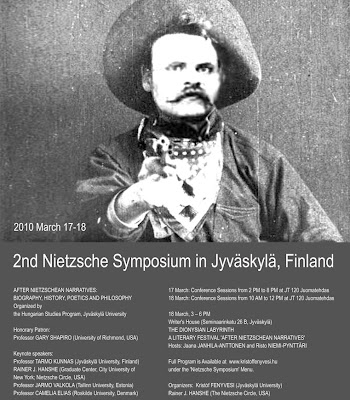
Spring does nothing for me. If anything, it makes me count the garments in my closet that I want to give away, and the ones which I want to keep. Each of my Rick Owens is a keeper. I praise myself for my good sense of style. While also thinking of my keynote address in two weeks for a Nietzsche Symposium in Finland—and what to wear. What business do I have to bust the German philosophy club? To write what, on the very first 'serious' author I had ever read as a child of 8. Before that, it was the 'eeny meeny miney mo' kind of literature that I was into. Of course, as an Americanist, I think of this opportunity as a crowning achievement. Achievement of nothing, of course, as Kafka and a few privileged others would know. In April, I'll be lecturing on liminal states in creative writing in Tromsø. The renowned Norwegian poet Liv Lundberg wants me to do a seminar for her students – anything on the borders, she said, all your aphorisms, fragments, prose poetry, and especially “the nothing that is.” Now I think that if I'll survive the Germans, the Finns, and the New Yorkers, all bona fide nerds of Nietzschean studies, I may want to say something about Nietzsche's shadow. It would be my way of revenge. Against fear. I'm afraid of Tromsø. It has a hold on me. Norway's energy field bends up there with such power that it makes me want to stay. But I am ever so pragmatic, I convince myself. I feel that the only reason why I can resist Norway is because I don't want to move up there for work. I want to move up there for 'nothing'. So unless a sack of money comes dumping on my head from the sky, I'm safe in my apartment in Trekroner. Imagine to live in a place called Three Crowns! Whose crowns? I want to be in possession of them all. Being the highest head, crowned thrice over. Having power over writing. Any writing. I'm looking at my emails. Some of them revolt me. Some I approach with resistance. And some I want to delete entirely. If writing is a form of love, it is also a form of revenge. Revenge against nothing. The nothing that is. It's 1.13 pm. I'm ready for a mass that consists of more than the Eucharist or lunch – dried fish from the Arctic. My mouth is dry. And yet, it can shout: Zarathustra, we're even now! Eat that. I'm off to read some poetry, in this wasteland of nothingness. Perhaps I'm ready for Nietzsche, after all, and Norway. The alfa and omega of the poor person who has money. Zarathustra encourages me to sing. Forget thinking, he says. It's time for the Hallowmass.
HALLOWMASS
by Lynn Emanuel
At one time this holiday celebrated the return of those who have died the previous year. The spirits entered their old homes and spoke to the living.
Man lives not by bread
He lives not by that potent grain
Nor lives he by love, nor goodness
He lives not by wisdom, nor righteousness
He lives not by the body of his mother
Nor by his father, by a woman he lives
Not, nor lives he by his children
Though time and time he longs
For peace and for a calm house, though
He longs for a rich life and a quick death
Nothing he hears is sweet, he tastes not
His hands build nothing, he touches nothing
He does not sleep or drink
For his eyes are beguiled
They have eaten on the stars.
And the sky is
Black and dry
As the mouth of the dead.
Though a man journeys and journeys
And he becomes translucent
As a god, even then
He cannot forget we who say
How memory kills a man
And memory wants the old secret wine
And it is like the dead
Who rise and dance on their chosen day
It is the sound of your dying
And you will not forget
You have heard me.
- (From Oblique Light, Slow Loris Press, 1979)