Although I want to say that it doesn’t matter to me where I go, there is always one place that comes into view that makes me say: ‘this is it and nothing else.’ Those following my ranting here will have guessed. That place is Norway. On top of a mountain I’m thinking of what Beckett said:
“All writing is a sin against speechlessness. Only a few, Yeats, Goethe, those who lived for a long time, could go on to do it, but they had recourse to known forms and fictions. So one finds oneself going back to vieilles competences — how to escape that. One can never get over the fact, never rid oneself of the old dream of giving a form to speechlessness.”
Although Beckett only mentions male writers, I have a feeling that he was more influenced by women writers. By writers such as Muriel Rukeyser who in her collection, Out of Silence, believes that writing is a form of love, which, instead of bypassing reason, allows for it to happen, if not as a mask, which one takes off, then perhaps as a form of immemorial memory, like snow. Gaston Bachelard writes in his The Poetics of Space that winter is a “simplified cosmos,” which makes me think that if a writer does go on with the writing, it is because of a need to step speechlessness on its toe. A frozen toe. Beckett liked to look at his toes. My sister was speechless in the snow after her toes got frozen. She made me sing an hymn with her as that was the only thing to do, she said, when the cosmos is too cold and white, and we can all die like animals. Like happy animals, she then added. I rather felt like stripping, but I let these words blend with the snow: “In the beginning, I would like to entrust myself to words that, were it possible, would be naked.” Thus spoke Derrida in The Animal that Therefore I Am.
We are all bookish animals. Some of us are into toes, others into navel or star gazing, and yet others into flying. Right now I imagine being the fat woman with fat legs, borne in the air by men with fat feet in one of Max Beckmann’s paintings. While this is the woman he’s waiting for in Paris, she prefers skating in Norway, even when skating is not something she can do. But there is something to her. There is something she has, as he puts it:
“Braunschweig 1903,
I begin this book in a very uncertain mood. One of my splendid hopes is shattered. She is not coming to Paris. I suppose I really ought to be sad? But I just feel empty. As if something I had hitherto felt to be pleasant and peaceful had been dragged out of me.
Now I have found another way to be contented.
I plan to be completely alone in Paris.
Shall I go on loving her, shall I forget her?
I don’t know. I shall see. But I don’t think so.
Because she does not love me as I need to be loved, though she does love me.
I cannot tolerate compromises. And this is one, however wrapped up in a cloak of self-sacrificing abstinence.
I know that in her place I would have acted differently. To hell with this damned reflection. I think Verlaine wrote something like: “Love has already fled, as soon as reason sets in.”
In five weeks I will be in Paris. Yes, yes, she had a neck. I doubt I’ll ever again see such a fine, delicate shade of gold as hers had. And the nape of the neck, where the head rests on the top of the spine, so fabulously elegant. When she wore her hair up, like a crown, she was the most delightful, delicate fairy-tale princess you could ever find in Grimm or Bechstein.
And it was such a delightfully comical contrast when she then talked so plainly and intelligently. Oh yes, she’s intelligent, all right. Too intelligent for comfort, and I think sometimes a bit bookishly intelligent. But I don’t want to be unfair.
It’s a shame that too much reading so soon puts an end to that delightful unawareness of one’s own personality. And there’s nothing more beautiful than when this sometimes pierces through the cold veil of conscious being (conscious being not in the philosophical sense).
Yes, she had to have something, first it was love, and now longing. I do believe that longing for something specific can sometimes be very beautiful. At least it fills, elevates, and even to some extent satisfies. The goal somewhere in the dim, uncertain distance – or even better, no goal at all, just an endless longing for the infinite –“ (Self-Portrait in Words, 21-22).
What was it that the toe-fixated Becket used to say again and again and again? “I can’t go on. I’ll go on?” Use your feet and go on with loving - and reasoning in the New Year. We don’t believe what Verlaine said. We are bookish lovers. We love by the book, we write with love, and are perfectly capable of going on with both. Call it cosmic simplicity, or whatever.
"If I were asked which of all the mysteries will forever remain impenetrable I would not hesitate to answer: the obvious." - (Edmond Jabès: The Book of Shares)
Tuesday, December 29, 2009
FEET
Tuesday, December 15, 2009
PULVERIZING PORTRAITS
Marina Tsvetayeva once said: “In this most Christian of worlds, all poets are Jews.” X-mas is coming, and we like poets. God, how we even love them. Especially the maddest ones, as they never have a problem identifying what ‘this’ is, namely the grandest of things that one can ever come across. God, how we love the high Romantic poets. They were all into ‘what might have been’ – as constant proof of the assurance of ‘this.’ And the lesson to learn from that! God, how sublimely and crushingly beautiful – if one gets it, that is. If one doesn’t, one can start here. With Tsvetayeva, Lynn Emanuel, and myself. All good Jews, in this most Christian of worlds.
Tsvetayeva made it into my new book on Lynn Emanuel by means of occupying the prominent and most important space, that of the epigraph. God, how we love to quote, how we relish epigraphs, and that most venerable art of self-publishing, of ruining our careers ever so uncompromisingly only so that poetry can happen. So, X-mas is coming. Such a tedious tide. Just think of the obligation of having to figure out what others want, and get it right. And how many of us take the time it takes to get it right? Now, that is the question. But here is a safe bet. In the face of not-knowing, buy poetry. Buy books on poetry. Eat words and force them down others’ throats. Die from choking. Imagine dying with a quote in your mouth. God, how we love the idea. And so we can continue.
Here’s Elias on Emanuel, then. Prophet on prophet. The book has been read by a few grand poetry experts, and they loved it. So, we take their word for it that your money won’t be spent in vain. And since you’re on amazon.com, make sure to throw in a couple of Emanuel’s own works into your basket. You won’t regret it.
Good and lavish holiday times to you all. I’m off to Norway.
PULVERIZING PORTRAITS: LYNN EMANUEL’S POETRY OF BECOMING
Table of Contents
Prologuing Portraits 9
Counter-frames 29
Becoming 45
Genius 59
Divas 75
Untitled 91
Portrait 107
Hegemony 123
Greeting 149
Counter-Mythologies 173
References 181
EYECORNER PRESS
ISBN: 978-8799245680
Sunday, December 13, 2009
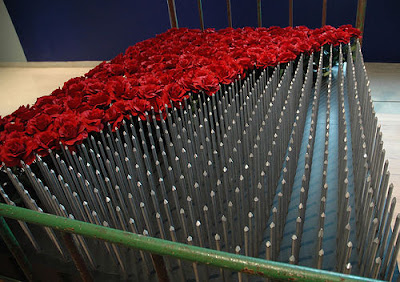
BED OF ROSES
For Mark Daniel Cohen
I lie on my bed and am making lists of cultures I prefer. The smell culture is at the top. The touch and the taste culture compete with the visual. The culture of the sixth sense is what it is: unfathomable. Through Bach, I’m synchronizing my zero energy with that of my friend, the Cohen of New York. His body is shattered to pieces. Fragments of leg scattered in the streets of New York are gathered at the hospital, also in New York. “Something dark,” he tells me. “Write something dark for me,” he insists, but I can’t. I think of the dark chocolate he received from his kid. A smart kid who was instructed well into the art of distinction. I’m not surprised. The Cohen is a poet, and as such he believes everything that Blake said: “Less than All cannot satisfy Man.” I’m thinking of bringing Romanian pastrami and chopped liver from the deli, and the fire, storm, and salt sea in the mighty cucumber in dill. The high note of the huge tone of rose absolute in my perfume, and one which only the trained ones can spot, interferes with the indole of the almost nature morte of the yellow leg. What does he love and long for, this writer himself, who also believes everything that Baudelaire said about the things that have “the expansion of infinite things”? Love and longing smell of vastness. My Rive Gauche and the stolen Calandre in it orchestrate a Merovingian dance. The long-haired king accepts the gift from the Snow Queen: grace as excess. The body turns olive again. And so does the mouth after finishing with counting what the sum of nine ones times nine ones is. Petals ascend and descend on the bed of elevens, heralding the Sun High-One.
Friday, December 11, 2009
Thursday, December 3, 2009
OLD MASTERS
For T.T.
Behind the curtain on Christmas Eve my mother’s voice merges with Bishop’s: “The art of losing isn’t hard to master / so many things seem filled with the intent / to be lost that their loss is no disaster.” Mother’s voice is as soft as the softest rain: “Watch now, how men will lose their one chance to kiss the alabaster of my face.” Widows and lesbian lovers “Lose something every day. Accept the fluster / of lost door keys, the hour badly spent. / The art of losing isn't hard to master.” “— Is she at home or not,” the horny men ask, but hers is not the task to answer to the charge of forgery and fidelity in life and in disaster. “I lost two cities, lovely ones. And, vaster, / some realms I owned, two rivers, a continent. / I miss them, but it wasn't a disaster.” The sounds get intense, and men’s excitement turns into a disaster. “This is a disaster,” they all shout. “Every year the same thing. It’s Christmas for Christ’s sake, indulge our lust, for once, and be a sport.” But “No,” she says, with Echo as her partner, practicing the art of losing even faster, one art which I am made to see as she refers once more to some disaster: “ — Even losing you (the joking voice, a gesture / I love) I shan't have lied. It's evident / the art of losing's not too hard to master / though it may look like (Write it!) a disaster.” “I’m listening,” I say, “But if it is as if it looks like it, like a disaster, then why do I have to write it, when those intended for, this writing of disaster, go back to eating, or opening their windows, disgruntled so by their fail to muster, or is it master, you?” “— Don’t move,” I say, “I’m painting you as implacable. Me, as lightness of touch on your lips, so that the one you’re waiting for will come at last. At last."
Tuesday, December 1, 2009
TEMPLARS
While lying under the able hands of an Arab masseur in Malta, getting a candle oil massage from top to toe - the scent is amber – I am irritated with myself. Here I am, close to history, the hermetic kind, and I am unable to get excited by all the legends about templars, fair maidens, and mystical experiences. I used to love costume drama, historical novels. I used to love believing that if only I could stand in close proximity to something that I think is unusual and special, then, my day would be made, and perhaps my future days too. But now I’m not so sure. My romantic and optimist self is yet inclined to say yes. Yes to the effects of proximity. My pessimist self says no; it makes no difference.
Getting a massage is good, however, as it always makes me think some abstract thoughts, which by virtue of their being abstract, are neither optimistic, and therefore potentially merely sentimental, nor pessimistic, and potentially merely cynical. They are in-between. So, after having touched the statue of a templar, and feeling nothing, the first thought that befell me, while in the hands of another, was this one: I don’t know what THIS is. I even visualized THIS in block letters as I render it now. THIS, thus and then, reminded me of a classical text, which is now largely forgotten: William James’s book The Varieties of Religious Experience (1902). In his chapter on mysticism, anticipating the one on philosophy – and there is a reason for the progression from mysticism to philosophy in James – he writes these lines:
“Whoso calls the Absolute anything in particular, or says that this is THIS, seems implicitly to shut it off from being THAT - it is as if he lessened it. So we deny the "this," negating the negation which it seems to us to imply, in the interests of the higher affirmative attitude by which we are possessed.” (352)
And why am I thinking of all this? Yes, good question. But I do have an answer. Because I couldn’t help wondering whether the more contemporary film line: “This is this, this ain't something else - this is this,” delivered by Robert De Niro in his stunning performance in The Deerhunter, has anything to do with the script writers’ awareness of the fact that Erich Maria Remarque may have been influenced by James’s psychological theories when he wrote the story Three Comrades in 1937, on which The Deerhunter is loosely based. (In my youthful days in Romania I used to read all the German realist classics, so for once it wasn't the 60s French movies that I had in mind while under spa treatment).
Treasures can be either found or rediscovered. After the incense experience, I went on to reading this passage from James, who quotes Behmen a few lines after the “this is this” line, and who talks about how primal love can be compared to Nothing as it is deeper than THIS, “deeper than any Thing”:
“And because [love] is nothing respectively, it is therefore free from all things, and is that only good, which a man cannot express or utter what it is, there being nothing to which it may be compared, to express it by."[...] "Love is Nothing, for when thou art gone forth wholly from the Creature and from that which is visible, and art become Nothing to all that is Nature and Creature, then thou art in that eternal One, which is God himself, and then thou shalt feel within thee the highest virtue of Love.... The treasure of treasures for the soul is where she goeth out of the Somewhat into that Nothing out of which all things may be made. The soul here saith, I HAVE NOTHING, for I am utterly stripped and naked; I CAN DO NOTHING, for I have no manner of power, but am as water poured out; I AM NOTHING, for all that I am is no more than an image of Being, and only God is to me I AM; and so, sitting down in my own Nothingness, I give glory to the eternal Being, and WILL NOTHING of myself, that so God may will all in me, being unto me my God and all things."[269] (James, 354)
My amber experience came after my ‘nothing’ paper, at the conference on Style in Theory/Styling Theory, and my reading about THIS ‘nothing’ came after that. In this context, I rather thought that such belatedness, or contretemps, can be considered as mystical as it gets under the circumstances, when the templar is silent.