Wednesday, October 28, 2009

LUDIC LAWS

With a slight belatedness of action, when we could not report on TV shows of interest due to incongruous events, we’re back in business bashing Vincent - as he doesn’t mind. But since we’re a conservative kind, before we say anything, a reference must be made as to the staging of this third set in the series The Power of Thought in which Vincent talks some philosophy with an invited guest, who is an expert in some related area. “Still no women on the list of names,” I want to object, even while feeling Whitmanesque today, embodying multitudes, and all. But mercy must be granted, for the following, more irrational than rational, reason: as Vincent was flagging my favourite country, and flaunted a Beckettian slim fit, we made a realization. Of course there’ll be no women on the show because the only one worth inviting will say ‘no’ to public appearances. I know this because that woman is myself. We thus acknowledge Vincent’s acknowledging of our uniqueness and singularity. In the face of what is possible, let us then stick to writing and let him stick to men. What’s fair is fair. “Immutable and just, the law. Justice is less sure of itself,” I thus write on behalf of the poet Jabès, whose words, which I would have quoted for the first instalment, still reverberate.

Game theory. Pelle Guldborg Hansen, who is a colleague of mine at Roskilde U was invited this week not only to offer some insights into the field but also to play a game with Vincent and a robot named Robert. The game was inconclusive. Vincent was bidding in a game of auction without thinking, and Pelle decided that insofar as he can decide that the robot is his he can thus win all the stakes all the same. This says something about the instrumentality of games, namely that something is always lurking in the wings which may well render the whole strategic, ludic structure in a game irrational. On this, I’m amusingly reminded of the statement in the preface to the book that Vincent and Pelle co-edited, a collection of interviews based on five questions, Game Theory, which says this about the material gathered in the answers from diverse luminaries: “The responses are self-contained and readable and no overarching view of the nature of game theory is lurking in the wings.” Believe we must what we all must.

Pelle made a distinction between the desire to win and the conviction which determines the actions taken towards maximizing one’s winning potential. This distinction submits to the rules of the game, which in principle are devised primarily according to convention rather than conviction. Especially since conviction can, at times, be shown to be grounded in fictitious or imaginary contexts. If, according to Pelle, the aim is to raise one’s son so that he would become a disciplined man rather than a loving one, then prioritizing discipline over and above love legitimizes the action according to the conviction that dictates precisely that discipline, and not love, is the rational rule to follow and enforce. Pelle mentioned no outcomes of such a decision, but I could imagine two scenarios: the son would be ready either for the military or philosophy – a win/win situation, some might add.

Then Vincent wanted to know about irrational acts in game playing. Here, Pelle introduced the notion of time. Irrational acts are deemed irrational, more often than not, not within a short-term perspective, or in the immediacy of when the act is committed, but within the perspective of lapsed time. In hindsight, we often say: “that was pretty dumb”, even if at the time of the event, the rule dictating the ‘now’ unfortunate act was deemed most rational. This shows that claims to rationality are in fact determined not by rationality per se but by cultural precepts and conventions. Within this framework, cooperation, rather than playing head against head is obviously a preferred strategy as it enhances collective wins as against total annihilation.

To my surprise, no one made a mathematical statement. What about winning strategies in an infinite game? I like players who play with strength rather than for closure, as this discloses some of the most profound and multifaceted processes of inner psychological drama that unfolds itself against the background of willed, yet not always predictable interaction. What happens when emotion rather than reason responds to counter-intuitive moves, thus heightening the intelligence of the game itself? On the cultural side, and in tandem with the more interesting set theorists, it may have been a good idea to mention in the show such figures as Michel de Certeau. In his influential book, The Practise of Everyday Life he makes a distinction between strategies and tactics. The first answers the institutional call, while the latter is more individual. How an agent creates space for himself to operate within, against yet also according to the existing structural powers, is already mind-boggling, as much of this space is defined tactically by repetitive – and paradoxically – unconscious acts. These acts are then deemed by agents rational even when they are illogical. Against this background, all those who claim to grow quite weary of the rationalists – myself included – have a point. For, what makes a game interesting is noticing that which has the tendency to slip past us – the irrational act included. Game theory would not be interesting game theory if it did not face us head on. Which means what, exactly? Which means that one has to start with a consideration of the poetic universe in homo ludens. If I were a game theorist, I would thus start with the words of Edmond Jabès in his book of aphorisms, Desire for a Beginning, Dread of One Single End.

"One possible approach to the [ludic] universe is simply to approach the possible.
Here the impossible comes up against the perennial problem of being inconceivable, a crucial problem that it keeps evading.
There will always be an impossible, undermined by possibility." (17)

Monday, October 26, 2009

JASMINE

On my way to get a body wrap in jasmine and a massage today, at a very nice place in Copenhagen called Ni’mat, I found myself at exactly 12 o’clock in front of Helligaandskirken, a church in the middle of the pedestrian street. I froze in front of it as the amazing church bells were sounding the hour. Not too far there were two other church towers whose bells were also competing for attention. While enjoying the sounds, I couldn’t help noticing, however, how many people were passing without noticing anything at all. Wrapped in sound, I counted: 1, 2, 3, until I got to 111. That’s how many heard nothing. This made me feel both quaint and queer.

Once arrived at Ni’mat, I was asked to wait in an oriental room. I sat on golden pillows and started smelling the flacons with oil essences on the table. This activity, smelling things, always transports me to all sort of places. I thought of mother who was the only woman I know capable of making sense of the space between the sacred and the profane. This was the woman who, while teaching me how to recognize and appreciate the sublime in all its nuances, also taught me that it was perfectly all right to be most vulgar, blunt, merciless, and uncompromising when needed. “You have to remember to laugh, though,” she said.

As I stepped into the steam bath first, my rising pulse started synchronizing itself with the still resounding church bells in my head. What is it that we’re doing, I asked myself, when we open ourselves for others, and let others open themselves for us? On the bench, as the masseuse pulled my hair and turned my head very quickly on its sides, I saw green colors.

After the jasmine oils, I had coffee at the beautiful old library. The décor was green and calming, but I was fussing. I had to catch my train back to Roskilde. I had a rendez-vous with Bach. This week they celebrate Bach in the provinces. The big cathedral invited everyone for a big night out, to sing the famous cantatas. As I was racing through the rain, my sister was waiting at the entrance. The church bells were tolling. She whispered: “you know, some folks back home would be green with envy knowing how much we enjoy this.” But I wasn’t so sure about that. More often than not, these days I find that most people I know don’t enjoy the things I do.

My sister is a great Bach singer, although she prefers Händel. The conductor said: “all, lights are green for Händel, so we’ll start with See the conqu’ring hero comes.” This instantly reminded me of a favourite quote delivered by one in the business of speed, the Formula One racing driver Mario Andretti: “If everything is under control, you’re going too slow.” Being under pressure is a mighty thing. Controlling the adrenaline without going mad! Powerful stuff, indeed, the G-force, the green lights. I went out of control while singing the next song, Sanctus from the Deutsche Messe by Schubert. There you have to be slow. Real slow. The conductor wanted us to sing that one 5 times over. He didn’t think we were slow enough. I wanted to join him on his podium. I wanted to turn to the large audience and say: “I’ll show you slow, out of control slow.” But I did nothing. And yet people were looking my way. My sister said: “it’s the jasmine,” while intoning Ave Verum by Elgar. “The whole church smells of jasmine,” she further said. I wanted to ask: “really,” but because I already knew it, all I said was this: “fast or slow, I believe that others believe in us.” I don’t know what people do with their lives in the evenings, but with Bach around, we can all give thanks. Mine almost sounded convincing as I blasted my lungs out singing Nun danket alle Gott. The jasmine was green, and a winner.
---
(Photo: Andra Jakstaite)

Friday, October 23, 2009

CONTACT

For Waltraud Meier

Earth to Jupiter. The 6000 needles piercing my body as I lie on my shakti mat shake my visual memory. Is there contact? There was nothing on the sky last night, but I can see now that Orion chased someone else. Not very far. A torrent of meteorites must have hit you on your head. Your head close to mine. Your small bone structure is vibrating. Numbers align themselves on the black. I won’t call. I hate telephones and dialling numbers is most quaint. I prefer other gadgets. My mind mostly. It can conjure constellations. In them my power over you is as endless as your love. No one can mess with Frigg’s distaff.


Thursday, October 22, 2009

PRAGUE

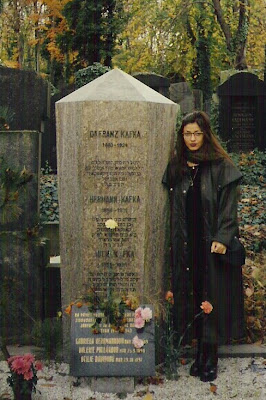
In 1996 I was in Prague for my birthday. I was 28 then. Smoother and about two kilos lighter than today. 48 kilos to be more precise. I was also stupider, both according to myself and others. This, now that I think of it some more, and unlike my weight and flesh, has actually remained a constant. As I had just moved in with a man I didn’t really know, most people thought I was either really stupid or really crazy. “Well, do you at least know how old he is?” they asked. “No, I don’t,” I said. “But why is that so important?” I asked in turn. I thought I knew just what I needed to know. Nothing more, and nothing less. I was not wrong. But then, how can you be, when the man’s idea of seducing you is by telling you that it really doesn’t matter what you are, who you’re with, and what you plan to do, as long as he gets to be with you 5 minutes a day - if you, so please, allow it. Well, I decided that a man like that deserved more than 5 minutes. Now, I never asked him why only 5 minutes would have cut it – I knew what I knew – and he never asked me why I wanted to hang out in old Jewish cemeteries on my birthday. But Kafka was the love of my life at that point, and that was all anybody needed to know. I wanted to go to Prague for the words. I wanted to see if I could experience sensuality through the interconnectedness of vibrations. I did. For, paying attention to what we do, say, and think is what energy is.

So, here we were, in Prague, shooting pictures, playing Jewish in the relevant quarters, stuffing ourselves with gefilte fish, and reading Kafka and Hölderlin in full foliage. Prior to this event, I tried to explain to all those who couldn’t understand how, after being presented with the possibility to move in, and was given the key to the apartment after one encounter that didn’t include sex, I did it the day after, and then ran off to Prague to indulge my literary tastes. But there was, however, one line, which I vividly remember shut the astonished female spectatorship up. Now I wonder why all the other things I said didn’t make such an impact, especially since nobody understood the profundity of it. I said: “I want him because he never sees me, or thinks of me as merely a fuckable subject.” And that in spite of my part, which, if I submit for a moment to the patriarchal idiom and order, I would have to say was not the part of playing the nun. When I then asked my female friends insistently, “do you know what that means?” I could tell that although their answer was “sure we do,” they sure as hell didn’t. On my 41st anniversary, I don’t raise my glass to the one who actually taught me what language does to us, women, culturally – oppress us for the most part – (he knows what he knows) – but to all those women who say, “sure,” when they’re not. May you all be fortunate enough to live with men who know better than ‘that’ – who trust your intelligence enough to know that if you do certain things, you do them for a reason!

Here’s what mine wrote in the Prague album he made for me:

“A book of photographs, arranged to pleasantly simulate a coherent narrative concerning an elopement-like pilgrimage to Prague, that venerable city of golden roofs, baroque tastes, and shrines to Jewish intellectualism, pride, and good merchant sense – introducing first the principals and differentiating them from their fellows: B., a man of little consequence and much pretence; the great K., a deceased Jewish doctor; and lastly, C., a dark lady of several aspects some of which are displayed within, for your viewing delight…”


Friday, October 16, 2009

WRITING ON THE WALL

Some two hours I’ve been wandering through the Swedish woods today to find two runic stones. While searching for the first one, which in the end I decided that someone must have stolen, square and simple, I stumbled over a sheep farm. Oh, this always makes me forget about all my frustrations and grievances. I’m good friends with sheep. They come to me running, even without my doing anything at all to entice them to it. And then they all bleat. Ever so loudly and enthusiastically that I can swear it’s a symphony orchestra I’m witnessing. During years of mutual attraction, I’ve also noticed that there’s always one sheep in the flock that develops a more intense attachment to me than the others. Today was no exception. Now, I tend to be pretty cool about saying goodbye to the creatures in general and the special one in particular when I’m ready to leave, but for some reason this one sheep today that must have seen me as honey or something, was very upset to see me go. But go I had to. On to finding the other stone, I urged myself on in order to avert the feeling of sadness. I found it. And yet, while feeling its lines and following its inscription something flashed through me. I had to go back and touch my sheep without my gloves on, and give it a name. So I did. Now, some would say that this is completely insane, but I can assure you that the love-stricken sheep didn’t think so. It was ecstatic. I named it Hestra. It was happy. And so was I. For a while, for it made me ask myself this question: why the fuck don’t I live on a sheep farm? Why the fuck not, indeed? I tried to answer this question by arguing with my position. I even threw in some alethic and deontic logic, but that merely made more upset. Luckily I was saved from such dry madness by Oscar Wilde’s insight: “arguments are to be avoided; they are always vulgar and often convincing.” I saw a whole different kind of writing on the wall. But I’ll keep that to myself. If I should be tempted to reveal the secret, I know where to find Hestra. I’ll whisper it into her ear.


Thursday, October 15, 2009

TOUCHING PERSEUS

For Ruth Gordon

Up north the stars shoot from the gut. Some claim it’s Perseus’s nether region that does it. I look at it, and look at it, and look at it some more. Some call this star gazing. The temperature goes down. I feel the zero on my toes. I make a wish. With my eyes closed. So it can’t be gazing that does it. Make it true. I know it. With my eyes closed I focus on my breath. My breath in art. Perseus may be well endowed, but it’s his navel I’m interested in. It smells like dark chocolate made with cardamom seeds. I have them on my tongue. The seeds. Their smell is the smell of our mixed blood. It comes out of my nostrils. I exhale - - - Your shirt goes up. I breathe into your navel. You’re waiting for my touch. Your whole body aches with memory and desire. I touch you, and you swoon. I touch you again. Your eyes open, and you swear on the stars that I am It. Not the stoning Medusa, but the other one. The secret one. The one with the trumpet, whose blow is a Gorgoneion apotropaic gaze that turns stone into a starring touch. You saw it. You felt it. You loved it. You want it. The foursome crystal constellation.


Tuesday, October 13, 2009

BAPTISM

And now to a discussion of rights, copy rights, and its relation to personal experience. I’m not in Denmark right now, so I have to put up with people’s stupidity as to the extent of enforcing rights to the left and to the right - the other right - so that ultimately, if you want to watch certain TV programs on your computer you are informed ever so politely about the impossibility of the fact due to whatever rights. Of course, the fact that it is ever so stupid to block transmission in this day and age of transmission is never mentioned. So, let’s just put it this way: as a general rule, rights have not been invented to help anybody but to create hassle. And this goes for every situation and that in spite of claims to the contrary. One does feel like smashing the gadgets every now and then. Lucky for us, however, when we are pursued by Murphy’s law: “if it doesn't fit, use a bigger hammer,” there’s always something else we can write about.

I was invited today for coffee in the middle of the Swedish wilderness. As it turned out, one of my colleagues is also vacationing very nearby where I’m staying, so I popped in. In the house there were two 6-year-old boys. Stephen and Valdemar. It started with Valdemar. I made references to his shirt that had a fire truck on it. On the upper half it also had some footballs with some odd graphic on them that looked like flowers to me. So I said: “Valdemar, what’s up with the marguerites and the fire truck?” Valdemar went on a roll explaining how I got it wrong. The grown-ups in the house were surprised. They told me that Valdemar has a speech impediment and is therefore shy. He was born two months prematurely. He is the kid of a friend of theirs and the best friend of their own son, Stephen. Well, speech impediment or not, it turned out that I could get anything I wanted out of Valdemar. He was smitten. Then Stephen. He came up to me and said: “what about my shirt?” “Oh la la,” I said, “the Eiffel tower! Have you ever been there, kissing your girlfriend on its top?” “No way,” he said, “I was underneath it, and no kissing.” Then I said: “Well, too bad for you. You don’t go to Paris if you are not up for some kissing.” He was also smitten. The ground for playing was open major time. They brought their pet to me, a huge toy, a moose. “What do we have here,” I asked, and “what is its name?” “It has no name,” the boys replied.” “What do you mean, it has no name?” I asked appallingly. “We have to baptise the creature instantly,” I then said, and waited for suggestions. “We’ll call it nothing,” Valdemar said. I gave Valdemar a very serious look. “Valdemar, unless you’re a philosopher, we’re not going to call the moose “Nothing.” “I do karate,” Valdemar replied. “Well then, you can start with bowing to me, and then here’s what we do: you each take a solemn position by my side, and at the exact same time you’re going to whisper a name into my ears. Valdemar said: “Stephen”. Stephen said: “Brille.” “Stephen Brille it is, then,” I said, and started the ceremony: “in nomine patre et fili et spiritus sancti, I baptise you, moose, Stephen Brille.” The boys were pleased and then ran to their rooms to hide under their quilts. Stephen was leading. I said, “hey, do you know what happens if you do that?” “No,” he said from under the quilt. “You invite me to come teach you how to kiss a girl, useful for your next visit to Paris.” Valdemar went wild, and Stephen expectant. We ended up back in the kitchen with both boys all over me. I placed my hands, with both my palms stretched, over their faces. First Valdemar, who was humbled, and then Stephen. And then something miraculous happened. Stephen did the same to me. He stretched his palms and ran them softly and tenderly over my face. Oh, what can I say? I was moved by such unfiltered openness. When I left I was still high and filled with emotion. And the boys, well, they were irremediably in love. It was a good day. Amen.

Monday, October 12, 2009

KADDISH

Today I ate something that I used to eat in Romania at orthodox funerals. Not the Jewish ones, but the Greek. Whole boiled wheat mixed with one kilo of ground walnuts, the peel from two lemons, and one orange, sugar, rum, and cinnamon. There was no funeral around, although I was convinced that if I went around offering some of this ritual and symbolic food to the tourists (mostly Danes) residing next to my cabin at the Isaberg resort in Sweden, some would have required instant burial. For you see, the stuff, called coliva in my mother tongue, tastes so good, that I wouldn’t be surprised to hear that people actually die from eating it. Of pleasure, of course. The mighty guitars of The Romeros were also on standby. So was Bach. And I was ready to officiate whatever there needed to be officiated. I’m good with blessings. Even the dead can use them. Walking through the woods, prior to the gluttony moment and visions of funerals all over the place, I was entertaining some new thoughts. The clearer the assumptions, the more I murmured to myself: blessed be this, and blessed be that, his and her name, this infinity and that endlessness, and so on. I even threw in some special words for Federman, who had just kicked the bucket last week: “Yehai shemai rabba mevarach lealam ulalmai almaya.” This line is full of eternal intentions. So, let all those still around and who get the picture, be blessed in their continuous ways.


Sunday, October 11, 2009

FOUR-FOLD

When I was 11 I fell in love with Bach transcriptions for the guitar. I had a record with Milan Zelenka, and I still remember vividly the effect of his chaconne on me. I grasped the infinite. Or so I thought. Now, when I doubt its omega-consistency (read this both metaphorically and à la Gödel) there is, however, a remedy. I always think of what Chopin said: “the only thing that sounds better than a guitar is two guitars.” My 11-year-old self returned today, on another 11, to that first experience, only this time raised to the power of 4. Here is The Romero Quartet, keeping it all in the family. All Bach specialists, and all to die for. We are forever grateful to all those who endure the pains of self-discipline only so that we may accede, through their perfect precision, to a consistent state of two-fold vibrations. Or three-fold, or four-fold, or more, if we are lucky.

Saturday, October 10, 2009

SCARLET TIDE

In the mountains I write my autobiography. The conceptual one. Which is exactly why the title of it will never be “No regrets.” While singing in the woods today, some pre-renaissance songs, tunes from Hildegard von Bingen, I thought about what enables us to rise above tautologies of the kind, ‘things are as they are.’ What we regret is often that we know better, or that we already know, or that we understand – that there is more to things as there is more to their existence. Thus, what we regret is that we don’t have the time and energy to be in the middle of things, in medias res. I’ve always wanted to be a medievalist, or rather a musicologist in the area, only so that I can get the Baroque contrapunctum. As with many other things, it never happened. Not officially, anyway. Which is why, while singing, I made other musical juxtapositions than the obvious ones. I thought of the beautiful song by Costello and Burnett sung by Alison Krauss, The Scarlet Tide. It sounds like an hymn. “We'll rise above the scarlet tide,” she sings intriguingly, but the line: “man has no choice when he wants everything" intrigues me more. So, man gives nothing when getting everything is not an option. But this nothing is not just nothing, it is a kind of nothing which holds both defeat and hope tied to a promise of the assurance of everything suspended by conditionality; man has no choice, but, if and only if, then and only then, thus and only thus. Indeed. And yet, when we do not give, we are not only cruel to others, we are cruel to ourselves. Cruelest, in fact. But we hold on to the thought of giving, such as it is, such as we imagine it to be, and such as we keep enunciating it.

The idea of voice is an interesting idea in medieval scholarship. It is tied with how one way articulation establishes proximity to the divine through a field of vision. The more God says nothing, the more man speaks. The clearer the vision, the louder the voice. Yet what is articulated is often the illusion of proximity to the divine. For, the most profound experience of the divine occurs when voice fails on purpose, so that the passage to the tautology tide is surpassed by a better tautology. When things are as they are, the thought that what comes, comes holds and paints the spirit scarlet. Tomorrow I’ll visit some monastery, here in the sacred land of Bohus, or step on petroglyph stones. They are also scarlet, as is the forest in full foliage, as is the silence of the suplicators.


Wednesday, October 7, 2009

FEDERMAN DIES

For Raymond Federman

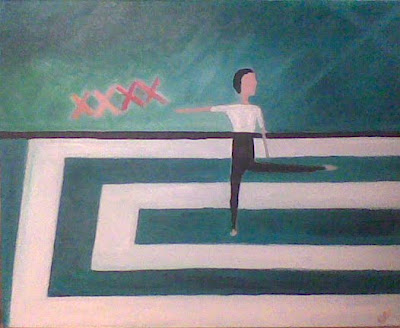
Nobody ever waits. Waiting is the hardest. And you decided to die on me just like that. Well, you have been dying for some time now, just like a few people I know. Mother was dying before she actually did it, some 20 years before. The same with Beckett. By the way, say hello to both. Perhaps you can instruct mother to start reading some Beckett while there, wherever it is that you’ve all gone. She was a Beckettian to the bone, only she had no idea. I’ve also been dying since the day I was born, so we have that in common. I came into this world two months before my time. Mother was sure I was going to die. Me too. And then with all the operations, it’s a miracle anyone survives. Three times I’ve had to spread my legs for the gynaecologist and anaesthesiologist. And then the energy thing. The ablation, they call it. Pumping up the heart to 400 beats so that they could guess where the current was, and burn its many passages. Six places they’ve burned it, chasing it in the dark. Which is why the current comes back, I can feel it. I’m ergodic proof of what instability means. And now I also want to get rid of my big tits. I have plastic reasons for it. I’m into the arts now. I want to seduce only myself, not others. And I fancy a splash of imitation. Beckett, whom we both love - that’s right, I want to look just like him. I wonder what you’d say of that, that I may die, finally, with my chest cut open. Who’s to say, indeed? We all die anyway. But meanwhile on your death, I’ve no idea why that obscene song sung by Serge Gainsbourg and Brigitte Bardot comes to my mind. "Moi non plus,” he says. "Je t’aime,” she says. But he insists. “Moi non plus.” Ah, well, people come, people go. You were never sentimental about that. And yet you made me soft in my knees. Your texts still vibrate through me. The words. I’m doing a painting for you now. I use mostly the color called viridian. Can you believe such a name? You would like it, particularly because I got the inspiration from my favourite perfume, YSL Rive Gauche. Total viridium. So, who will read at your funeral? I’m busy writing, and feeling sorry for myself, so I'll absent myself. Goddamned it, Raymond. You could have waited for me. You make me say, “moi non plus.” You exit, but I promise, I’ll take care of the X.

§

Sunday, October 4, 2009

FUGUE

Robert, this one is for you. On your birthday. Bach played by Gould. On his death day. Unoriginal and morbid. I know. But then again. Listen to this, and then think of all those who inspired Gould, all those Russians, such as Rosalind Turek, and all those Russians whom he then in turn, in an act of heightened generosity paid back, and inspired in 1957 when he was a young and ravishingly rapid, dashing man in Moscow. Tatiana Nicolajewa never played Bach other than by stepping on the pedals all the time. All the time. Such was the time then. All those Russians who never tasted the Baroque and its excesses! They were all coming out of the Romantic tradition. They were all in love with Bach, sublimely. How to have him? How to accede him? How to do him? But things are simple really. And constant. What Bach wanted was God, and what God wanted was to touch Bach. Gould understood this when he got older, and was infinitely more in touch. We all get what we want, if we listen, if we come. For the touch and the solitude. For the love. En courante.

Saturday, October 3, 2009

RESCUING

Today my Saturday begins with two reflections: 1) if you want to make it in this world you have to do what there is to do to make it, among other things make sure you pile up the diplomas, awards, medals, and the like. This thought was sparked by a mail from my friend, Robert Gibbons, who needed to send a letter to a head master somewhere in the US of A. The master lists his achievements in his very signature: 3 MAs, 2 PhDs, 2 professional certificates, and many more things – you get the picture. Robert says to me: “I must say, that the credentials possessed, accomplished, sought, won, bought by this headmaster are as good as any I've, seen, at the same Time revealing for the entire years' search, the futility of it ALL!!!” This made me think about how right the poststructuralists were to have made the obvious and commonsensical remark: men with such credentials are in power, not because they are essentially smart, but because they’ve managed to convince others that they are, women included. So it’s all in the narrative. To understand this even better, it’s enough to look at politicians. If we didn’t live by fragments and details, the campaigners would not keep so busy with the respectable trade of digging. Digging dirt that can tell a different story about the one who claims to be spotless. So the big picture is always in the small picture. Obama has been in Denmark for 5 hours and a half to try to get the Olympic games to Chicago. He didn’t succeed, yet everybody agreed that his mere presence in Denmark was big. So big. A very big thing, indeed! Now, I thought, if Obama had a different reputation than the one the media construe, say, that of a womanizer, or something similar, I wonder how big his presence here would have been deemed, you know, cosmically speaking. For when people go and say that it’s fucking big that he’s here, they never elaborate. They just believe.

Which brings me to my 2nd reflection: on belief. While I was in the bathroom, my husband played a vinyl with some Indian tunes produced by L. Shankar, a major violin virtuoso. Listening to the sounds as they were filtered through two doors, they reminded me of a Somali tune. This thought then reminded me of a prose poem I wrote last year which I dedicated to a Somali friend. In that poem I made a reference to Ketav Levonah, the white Torah. The word levonah itself means incense, which the poem is actually about. So there I was, smearing creams on my body, thinking of smell and religion. After I finished I sat by my computer and amused myself with checking to see who has been visiting my blog. Looking at my stats is a wonderfully entertaining moment of wasting time. One phrase caught my attention. Someone from Sacramento, California was searching google for “Ketav Levonah,” and, voilà, google being very smart directed the person to my website. All the better, as I never had anyone stumble on my writing with that phrase before. So I made a mark of it for posterity like a good statistician, while I also wondered what the poststructuralists would make of this kind of coincidence that seems to bypass the two-dimensionality of the stories that make up our identity: either you are this, or you’re that. There’s no middle way. Of course, if I declared that I "believed" in cosmic things, they would assure me that that is a sure way to madness, in this world precisely in which it ain’t the stars that rule but the star-achievers. In other words, “belief” is the wrong tool to employ in making statements that run counter to reason.

Humm, my fingers are tapping nervously on the table as we speak. I have to think about this one some more, and the damned philosophers into belief and decision-making are still out there deliberating. As yet, they haven’t produced anything sensible on the very topic. Jack-shit, in fact. So I’m thinking: if I don’t “believe” in anything, I’d have to conclude this based on hard evidence: I know for sure that I’m not a “fan” of politicians, and I also know for sure what I like. I like to quote Kafka on achievement: “success is the biggest disappointment.” Ooohhh, I can hear Homer Simpson interjecting: “Aaahhh! Then you’re a loser.” Damned! I knew there was something wrong with me. Anyone into the business of rescuing? A volunteer? Thank god for volunteers.