Tuesday, June 30, 2009
COSMIC ACT
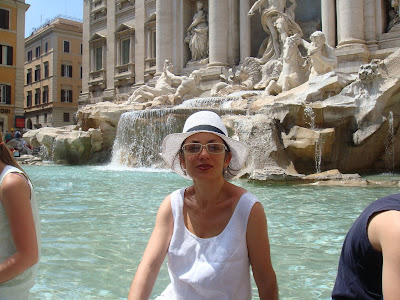
One of the good things about being in a big city like Rome is that if you go out for a drink anywhere, you can easily happen to sit next to people you’ve seen before. Like actors, for instance. Today, after doing the major sites in the Eternal City in hot sun, after having done my wishing to be eternally loved by throwing coins into Fontana Trevi, I decided to get a beer at one of the local joints near the Spanish steps. As I was leafing through my Italian copy of Italo Calvino’s Cosmicomics, which I had just mentioned in my previous post, and which I had just bought, I noticed a man and his son at the opposite table. I thought, gosh, either this guy is Tim Roth or he really looks like him. As Tim Roth is one of my absolute top favourite actors and his work in Rosencrantz and Guildenstern are Dead is absolutely beyond top class, there was only one way of finding out whether I was sitting next to a very intelligent actor, or a fake. I took my book, and went up to him with these words: “Tim Roth, if I ask you to give me an autograph, are you going to curse me?” He signed ever so courteously. Don’t ask me why I thought - after I had left the two, who, as I passed them in my big hat, were smiling grand style at me, yet also mysteriously - that if anyone should have signed that book, then it would have to be Roth. Cosmic things indeed, and a sense of falling. Come dice Calvino: “Cadere nel vuoto come cadevo io, nessuno di voi sa cosa vuol dire.” (La Forma dello Spazio)


Saturday, June 27, 2009
MOON
I’ve just had the best sailing time in my life in the North Atlantic, around the Faroe Islands. The islands in themselves have a smell that keeps you thinking of the great Beyond – you basically walk around while being in a constant state of swooning. It makes you think of silly religious revivals when people thought that they would get transposed at a touch, to where I have no idea, but transposed they all believed they were. There isn’t much religiosity left on the islands, apart from a regimented alcohol prohibition that no one cares much about in this globalized world full of traffic opportunities – let’s face it, I had no problem getting into the country a whole litter of Fernet Branca that I know goes very well with dried fish and lamb entrails that I bought on the ferryboat with money won in the casino, also on the boat. So, between eating, drinking, gambling, and smelling, once on the main island, Stroymoy, I also got to sail in a large boat, a sloop with sails from the 40s. The waves were high around the corners of the cliffs. I experienced an altogether different type of G-force created by the mighty boat hitting the waves, after the bow had been 10 meters in the penetrating air of the North Atlantic. This was not a hit and run, but a hit and glide. I thought I was going to die, but I laughed, I so laughed.
I was among the few on board who was neither cold nor suffered from sea-sickness. I used my adrenaline as an energy weapon against the wind which cut through you. I thought of salted energy. “Of course I’m not cold,” I thought to myself while watching the green faces and tormented bodies around, and I was convinced that this resistance had to do with Italo Calvino’s short stories in his Cosmicomics. “The Distance of the Moon,” “Games without End” and “The Form of Space” came to my mind. These are stories about captains and other good folk whose names, derived from mathematical formulae, throw you into interminable laughter on the spot and you are right there with Qfwfq when he tells you: “Climb up on the Moon? Of course we did. All you had to do was row up to it in a boat and, when you were underneath, prop a ladder against her and scramble up.” Captain Vhd Vhd, his deaf wife, and their daughter Xlthlx, can never resist the attraction from the moon – so they climb it all the time also to collect moon-milk. This is the time when the moon was close to the earth and the earth had not lost almost all of its energy, claims Calvino. I liked this thought. On my boat, it made me think of what name I would assume, the minute I would plunge into the cold water of the Atlantic, the minute the ocean would become a pink sky, the minute physics and smell would replace the desire to have the moon, and not just climb it: SQRT.


I was among the few on board who was neither cold nor suffered from sea-sickness. I used my adrenaline as an energy weapon against the wind which cut through you. I thought of salted energy. “Of course I’m not cold,” I thought to myself while watching the green faces and tormented bodies around, and I was convinced that this resistance had to do with Italo Calvino’s short stories in his Cosmicomics. “The Distance of the Moon,” “Games without End” and “The Form of Space” came to my mind. These are stories about captains and other good folk whose names, derived from mathematical formulae, throw you into interminable laughter on the spot and you are right there with Qfwfq when he tells you: “Climb up on the Moon? Of course we did. All you had to do was row up to it in a boat and, when you were underneath, prop a ladder against her and scramble up.” Captain Vhd Vhd, his deaf wife, and their daughter Xlthlx, can never resist the attraction from the moon – so they climb it all the time also to collect moon-milk. This is the time when the moon was close to the earth and the earth had not lost almost all of its energy, claims Calvino. I liked this thought. On my boat, it made me think of what name I would assume, the minute I would plunge into the cold water of the Atlantic, the minute the ocean would become a pink sky, the minute physics and smell would replace the desire to have the moon, and not just climb it: SQRT.


Thursday, June 18, 2009
RETREAT
For Ursula Renz
Between the Arctic and Austria we step on stones made out of chocolate truffles. “How did you know, I ask?” and the wise woman says: “I just did.” You know, she then says, “absolute nothingness is not an abstract.” "I know," I say, “abstracts have forms, absolute nothingness doesn’t.” She nods and takes a deep breath. Mountain air is between us. We climb high and agree that closure is not in our vocabulary. I see Spinoza as the Hunchback of Notre Dame. She can also see that. Three weeks in the mountains carrying Spinoza on your back will do that to you – make you see things. Moses Cordovero is shaking his head. “Crazy women,” he thinks. And I go: “hey, you’ve got exactly 3 minutes to state your case.” “Form is stripped away by the power of ayin,” he says, and I ask: “where did you get that from?” But he keeps silent. “Can Kierkegaard have a word?” the other woman asks, and then says: “Don’t go cosmic. Kierkegaard thinks it’s a bad idea.” But Kierkegaard didn’t read any Freud or Lacan, so I’m not afraid. I lose my patience, and say: “all I ever want from you, men, is to answer this question: “what does it mean to say: ‘I’m here,’ in the light of nothingness, no point, and no form?” Isaac the Blind has an insight: “The inner, subtle essences can be contemplated only by sucking… not by knowing.” We are childless women. The wise woman eradicates the materiality of time: “even if seven years pass, seven mountains are climbed, and seven oceans crossed, you come to me and say, ‘I’m here,’ and it will be enough.” We divulge no secrets, for we are thieves in hiding.

Between the Arctic and Austria we step on stones made out of chocolate truffles. “How did you know, I ask?” and the wise woman says: “I just did.” You know, she then says, “absolute nothingness is not an abstract.” "I know," I say, “abstracts have forms, absolute nothingness doesn’t.” She nods and takes a deep breath. Mountain air is between us. We climb high and agree that closure is not in our vocabulary. I see Spinoza as the Hunchback of Notre Dame. She can also see that. Three weeks in the mountains carrying Spinoza on your back will do that to you – make you see things. Moses Cordovero is shaking his head. “Crazy women,” he thinks. And I go: “hey, you’ve got exactly 3 minutes to state your case.” “Form is stripped away by the power of ayin,” he says, and I ask: “where did you get that from?” But he keeps silent. “Can Kierkegaard have a word?” the other woman asks, and then says: “Don’t go cosmic. Kierkegaard thinks it’s a bad idea.” But Kierkegaard didn’t read any Freud or Lacan, so I’m not afraid. I lose my patience, and say: “all I ever want from you, men, is to answer this question: “what does it mean to say: ‘I’m here,’ in the light of nothingness, no point, and no form?” Isaac the Blind has an insight: “The inner, subtle essences can be contemplated only by sucking… not by knowing.” We are childless women. The wise woman eradicates the materiality of time: “even if seven years pass, seven mountains are climbed, and seven oceans crossed, you come to me and say, ‘I’m here,’ and it will be enough.” We divulge no secrets, for we are thieves in hiding.

Saturday, June 13, 2009
HEEL
For Hélène Cixous & Kathleen Ferrier
From where we stand – always in square one – always before the beginning – always before the end – always under the spell – always in the middle of the greatest passion – always dialectically vigilant – but deconstructive – you give me your love – always conditioned by the unconditional – by everything and nothing. We are in the subplot of Don Quixote, when Quixote reads about himself – in Hamlet’s subplot, when Hamlet gazes on himself, how spectacular! – in the 602nd story of the Arabian Nights 1001 cycle, when the king hears about the murderous but desirous king, himself. It’s all about penetration. “I can’t let you be part of my life," you say, while penetrating mine, while doing it all the time by opening a door made out of flesh and bones. My clavicle feels the warmth of your hand like a penetration. My hand on your hand consolidates the magic. – Salve! Orbis terrarum est speculum Ludi. We are X-ing the geometry of the point, repairing the intentional fallacy that left Achilles’ heel without coverage. Spot on, we penetrate the heel with our gaze, healing it, so Achilles can run faster from the time that stands still. From where we stand, we read about ourselves in the most magical of all touches.

From where we stand – always in square one – always before the beginning – always before the end – always under the spell – always in the middle of the greatest passion – always dialectically vigilant – but deconstructive – you give me your love – always conditioned by the unconditional – by everything and nothing. We are in the subplot of Don Quixote, when Quixote reads about himself – in Hamlet’s subplot, when Hamlet gazes on himself, how spectacular! – in the 602nd story of the Arabian Nights 1001 cycle, when the king hears about the murderous but desirous king, himself. It’s all about penetration. “I can’t let you be part of my life," you say, while penetrating mine, while doing it all the time by opening a door made out of flesh and bones. My clavicle feels the warmth of your hand like a penetration. My hand on your hand consolidates the magic. – Salve! Orbis terrarum est speculum Ludi. We are X-ing the geometry of the point, repairing the intentional fallacy that left Achilles’ heel without coverage. Spot on, we penetrate the heel with our gaze, healing it, so Achilles can run faster from the time that stands still. From where we stand, we read about ourselves in the most magical of all touches.

Tuesday, June 9, 2009
ON THE CLOCK
On occasion, one would like to say that there is nothing more to say. But those of us who know better also know that there is no such thing as silence – except for the kind we can conjure in our own heads if we are smart enough. For, as John Cage once remarked, even if you were to isolate yourself in a room completely devoid of sound, you’ll still hear your heart beat and your blood running through your veins. This being said then, and remaining true to the deconstructive aim to denounce stupidity every time we spot it, here is a thought on Vincent’s encounter with Frederik Stjernfeldt – a personnage who, on his academic website with Aarhus University, declares is “against scepticist, vitalist, and deconstructivist views of many kinds,” being more “predisposed to a realist view of semiotics.” Right.Now, one would like to know why I choose to quote from Stjernfeld’s webpage rather than report on what he says on screen. There is a reason for this. I’m bewildered. What I’m watching is a re-run – the last episode in The Power of Thought series from last year, in which Vincent and Stjernfeldt talk about epistemology and logic. I can’t help thinking to myself: this is fucking déjà-vu, twice over: while Vincent and his guest are not absent from the program as such, they are not present either. They are on my TV, all right, but not with something new; not with what was announced: Vincent with Stjernfeldt on multiculturalism. From a pragmatic point of view, there is only one thing to say: someone is being very incompetent. From a deconstructive point of view – the kind that Stjernfeldt is against – there are many more things to say.
So, let’s say something, now that we’ve got ourselves so worked up. However, as I’m not interested in talking nonsense behind people’s backs, as it were, I’ll make this remark only, sparked by Stjernfeldt’s webpage where he rejects the school of deconstruction in favour of adopting a neo-conservative stance. While I would have been interested in hearing what he has to say about multiculturalism, I am quite certain that I would have pointed out this irony: that the best definitions of multiculturalism are provided precisely by scepticists – (see Multiculturalism from the Margins by Dean A. Harris), vitalists (see Gilles Deleuze’s Vitalism and Multiplicity) and deconstructivists (read all of Derrida, and don’t cheat). Insofar as deconstruction dismantles imperial ideas from within, through identifying the aporias and inconsistencies within the system of ideas itself, dismissing deconstruction is, to me, nothing more than an act of folly, for what is more refreshing than the fact that deconstruction, in its enabling a democratic multicultural discourse also identifies that very democracy perhaps even as a dictatorship of multiculturalism? The same goes for the metaphysics of presence, indeterminacy, and cultural paranoia.
By way of closing this post, let’s end with the words of an intelligent man, Elias Canetti, who, in his brilliant book, The Secret Heart of the Clock, has this to say, hinting, of course, at acts of silence and absence, also embedded in writing strategies such as quoting:
As I write this, I discover, however, that some things remain consistent, in spite of everything. The TV is still on – and lo – Vincent is on again, with another topic from a previous program, the turning of reality program, namely, the 6th VVV instalment on infinite love....... As I watch it again, I think to myself: there are two possibilities here: either Vincent is very smart, and uses all sorts of strategies to keep us interested including deciding which instalment to be repeated when, even when there aren’t any new ones to repeat; or else (2) he’s very lucky. For, you see, the idea of infinite love is bound to make at least some of us less bewildered, and yes, keep us interested. But whatever the situation, let’s just say that today’s absence has been saved by the clock, not care. Where deconstruction itself is concerned, the fact that the show seems to dismatle itself, by never being consistent with what it announces, nor with when it airs, is a brilliant example of how, while one may not have the adequate theoretical knowledge of how deconstruction works, one can see it in action all the time, like clock-work indeed.Nothing has changed in me, but sometimes I hesitate before pronouncing the name of the enemy.
From Wittgenstein’s: “Vermischte Bemerkungen”:
“The proper greeting among philosophers should be: Give yourself time!”
“The philosopher finds more grass in the valleys of stupidity than on the barren heights of cleverness.”
Philosophers one gets entangled in: Aristotle.Philosophers to hold others down with: Hegel.
Philosophers for inflation: Nietzsche.
For breathing: Chuang-Tzu.
The philosophers condensed into a pack of cards.
Monday, June 8, 2009
DIVINATION
For Andra Jakstaite
I am the diviner. The wandering rabbis search for wells, but only I know how deep they are and where they are. In their order of things, they go ahead, I go behind. In my order of things, they don’t even exist – lavish absence. This is a syllogism of the suspended middle. I integrate faith and reason in a way that the patriarchs don’t. But they still need me to tell them how grace can remain a free gift. The word is made strange in their scrying. “Who has ever heard of a feminist diviner?,” they ask. That’s because I don’t believe in their stolisomancy, sortilege, and scarpomancy. “What’s the word for today?” they ask. And I say: “Mercury. Have you ever wondered why he’s always depicted on one foot? On top of a building, if a statue? Get your cameras and shoot the one in Copenhagen.” “Oh, come on,” they go. “Why do we have to do this?” – Because it’s spring, and because you’re poets.


(Photos: courtesy of and by Andra Jakstaite; painting, CE, after the motif in the photo)
I am the diviner. The wandering rabbis search for wells, but only I know how deep they are and where they are. In their order of things, they go ahead, I go behind. In my order of things, they don’t even exist – lavish absence. This is a syllogism of the suspended middle. I integrate faith and reason in a way that the patriarchs don’t. But they still need me to tell them how grace can remain a free gift. The word is made strange in their scrying. “Who has ever heard of a feminist diviner?,” they ask. That’s because I don’t believe in their stolisomancy, sortilege, and scarpomancy. “What’s the word for today?” they ask. And I say: “Mercury. Have you ever wondered why he’s always depicted on one foot? On top of a building, if a statue? Get your cameras and shoot the one in Copenhagen.” “Oh, come on,” they go. “Why do we have to do this?” – Because it’s spring, and because you’re poets.


(Photos: courtesy of and by Andra Jakstaite; painting, CE, after the motif in the photo)
Saturday, June 6, 2009
ELEVENTH
As an amateur psychoanalyst in my spare time, I often get confronted with one problem which seems to override all others: the question of people’s lack of ability to understand what their emotional and intellectual range consists of, how far it stretches, and to what extent it can be expanded without the ensuing feeling of guilt conditioned by culture, usually manifested in the exclamation: ‘my god, I’ve just transgressed orders!’ (tradition, rules, morality, or some other such idiotic constraints which have nothing to do with what one can experience if one allows oneself to see past ideologies that cannot legitimate their existence). What I do that is successful is put people on a path that enables them to understand that the only thing that can escape guilt and regret is art.
Today, for instance, I told someone that when I came to Denmark and was eager to continue my education, my choice of study was very much the result of my inability to speak the language. I ended up picking neither law, nor theology, nor math. Initially, with law, it was Kafka who did it. With theology it was the ancient text that did it. With math, it was infinity that did it. Now, discarding law and math was not so difficult, as both subjects were more the figment of my fantasy about concreteness, in the case of law, and mysteriousness, in the case of math. Discarding theology was more difficult as I even thought of going all the way – that is, I actually imagined myself as a Lutheran priest. In spite of its paradoxical nature, I also ended up discarding theology not for its unreality – for, let’s face it, institutionalized doctrines have as much legitimating ground as any Sci-Fi novel when it comes down to it – but for its reality: I said to myself, you’re going to pass the Greek, the Latin, and Hebrew exams, but you’re never going to pass the Danish exams. So much for my triumvirate! Off it all went. So, I have regrets. That is, until I pick a work of literature that makes up for it at least threefold. Thus my advice to all those who have regrets is this: read something intelligent and thoughtful or look at or create yourself images that are intelligent and thoughtful. That’s all.
Here’s what I read today, which then I immediately associated with the epic of Gilgamesh, particularly the eleventh tablet in which we are told the story about how Gilgamesh fucked up twice in his attempt to prove that he was worthy of the gift of immortality. And boy, did he regret that!
But first, and last, for today, a text from the Zohar (Lech Lecha 77a). Its mathematical order and appeal to interpret it kept me busy the whole day. Here’s a self-evident statement: when you’re busy thinking about texts or visual art, not only do you not have any time to get bored, but it is quite impossible to have regrets. The only regret you can have is that you cannot shut up. As Jabès once pointed out: “our decision to write, to talk, springs from a lack.” And boy, how I want to be complete right now, even though completeness is the biggest fiction there is. But then, so it goes. We have as yet to earn our right to immortality and all that continuity and completeness that goes into it.
1. One climbs to one side.
2. One climbs down on that side.
3. One enters between these two.
4. Two crown themselves with a third.
5. Three enter into one.
6. One comes forth in many colors.
7. Six come down on one side and six on the other.
8. Six enter into twelve.
9. Twelve agitate themselves to form twenty-two.
10. Six are contained in ten.
11. Ten are fixed in one.

Today, for instance, I told someone that when I came to Denmark and was eager to continue my education, my choice of study was very much the result of my inability to speak the language. I ended up picking neither law, nor theology, nor math. Initially, with law, it was Kafka who did it. With theology it was the ancient text that did it. With math, it was infinity that did it. Now, discarding law and math was not so difficult, as both subjects were more the figment of my fantasy about concreteness, in the case of law, and mysteriousness, in the case of math. Discarding theology was more difficult as I even thought of going all the way – that is, I actually imagined myself as a Lutheran priest. In spite of its paradoxical nature, I also ended up discarding theology not for its unreality – for, let’s face it, institutionalized doctrines have as much legitimating ground as any Sci-Fi novel when it comes down to it – but for its reality: I said to myself, you’re going to pass the Greek, the Latin, and Hebrew exams, but you’re never going to pass the Danish exams. So much for my triumvirate! Off it all went. So, I have regrets. That is, until I pick a work of literature that makes up for it at least threefold. Thus my advice to all those who have regrets is this: read something intelligent and thoughtful or look at or create yourself images that are intelligent and thoughtful. That’s all.
Here’s what I read today, which then I immediately associated with the epic of Gilgamesh, particularly the eleventh tablet in which we are told the story about how Gilgamesh fucked up twice in his attempt to prove that he was worthy of the gift of immortality. And boy, did he regret that!
But first, and last, for today, a text from the Zohar (Lech Lecha 77a). Its mathematical order and appeal to interpret it kept me busy the whole day. Here’s a self-evident statement: when you’re busy thinking about texts or visual art, not only do you not have any time to get bored, but it is quite impossible to have regrets. The only regret you can have is that you cannot shut up. As Jabès once pointed out: “our decision to write, to talk, springs from a lack.” And boy, how I want to be complete right now, even though completeness is the biggest fiction there is. But then, so it goes. We have as yet to earn our right to immortality and all that continuity and completeness that goes into it.
1. One climbs to one side.
2. One climbs down on that side.
3. One enters between these two.
4. Two crown themselves with a third.
5. Three enter into one.
6. One comes forth in many colors.
7. Six come down on one side and six on the other.
8. Six enter into twelve.
9. Twelve agitate themselves to form twenty-two.
10. Six are contained in ten.
11. Ten are fixed in one.

Labels:
autobiography,
psychoanalysis,
reading
Wednesday, June 3, 2009
G-FORCE
Here’s my idea of a natural death: getting a heart fibrillation or some such high electrical impulses in the middle of a string quartet concert. Ever since I’ve discovered chamber music at the age of 9, I’ve been thinking about it. Call me a conservative. After a tour in the Tivoli gardens with my sister, who can never get enough of the meanest roller-coasters – none of those in Tivoli, alas – we got pulled by gravity while swerving over high class performers, The Emerson String Quartet, at Tivoli’s concert hall. “Give me NASA”, my sister said, just before the beautiful Dvorak – and thinking about floating in space as an astronaut – she can take the real G-forces like no one I know. But I got whirled into the supremely rendered Bartok. I told my sister: “you know, it’s not enough to have good coordination in a string quartet. You need good flow. If you can hit it, and suggest a flight towards infinity, then you’re a master.” My sister believes everything I say. So we had a good night – no deaths yet. Meanwhile, this thought, that if we stay with it, the flow, that is, we may even get famous before the finals, resounded on another level too.
For as it happened, earlier today I got pulled into another world as well. An Italian literary salon, featuring the art project Immagine & Poesia, a project based in Turin that aims at promoting what the curators call ‘creatività incrociata’ – or cross creativity – asked me if I would share my paintings that have a poem tagged to them on their various websites. “Sure,” I said, “I’m all for open source” – and I like coincidences: one of the leading figures in the project is Dylan Thomas’s daughter, the writer, Aeronwy Thomas. “Which painting do you want,” I asked, and suggested one which is special to me, and which inspired my whole pictorial inceptions. “Yes,” the curator said, “but to begin with, we want Infinity A-1.” Ah, I thought to myself, there is a chance to escape to infinity in a Newtonian potential in which boundedness is ensured under the action of the force field. I wanted to tell my sister something about escape velocity, which is the speed that gets you to infinity – well, barely – and the sense of what getting there at zero residual speed might be like. But I kept silent. I’ve always liked the idea of “to begin with.” The strings evoked that, and more.
Here’s INFINITY A-1 – in Salotto Letterario, in La Stampa, and in Image and Poetry.

For as it happened, earlier today I got pulled into another world as well. An Italian literary salon, featuring the art project Immagine & Poesia, a project based in Turin that aims at promoting what the curators call ‘creatività incrociata’ – or cross creativity – asked me if I would share my paintings that have a poem tagged to them on their various websites. “Sure,” I said, “I’m all for open source” – and I like coincidences: one of the leading figures in the project is Dylan Thomas’s daughter, the writer, Aeronwy Thomas. “Which painting do you want,” I asked, and suggested one which is special to me, and which inspired my whole pictorial inceptions. “Yes,” the curator said, “but to begin with, we want Infinity A-1.” Ah, I thought to myself, there is a chance to escape to infinity in a Newtonian potential in which boundedness is ensured under the action of the force field. I wanted to tell my sister something about escape velocity, which is the speed that gets you to infinity – well, barely – and the sense of what getting there at zero residual speed might be like. But I kept silent. I’ve always liked the idea of “to begin with.” The strings evoked that, and more.
Here’s INFINITY A-1 – in Salotto Letterario, in La Stampa, and in Image and Poetry.

Labels:
autobiography,
music,
my paintings,
places
Subscribe to:
Posts (Atom)