Saturday, May 30, 2009

FLIMERICKS

The Finns are in love with me. And I in love with them. This also goes for the Finns who are not really Finns, but have lived long enough in Finland to pass. Say, at least 30 years. There are reasons for the love. But, keeping with the Finnish custom of not saying much, they shall remain undisclosed. There'll be hints. Those with the necessary cultural competence will know just what I mean. At conferences we congregate in silence. We sit together. We touch. If there is talk, or whispers – as the case may be during other people’s talks – then they are produced by me. The same goes with touch. Such bodily or silent discourse usually takes place on a higher plane of understanding than the ordinary. I talk, they listen. I touch, they watch. The Finns are into rescuing. When I go, boldly addressing the now former president of NAAS, “Jopi, write me a note” – during a dry talk – “lest I should die from boredom” – he obliges. When he doesn’t, he gives me a special look, and with his arms demonstratively crossed over his round belly, he says, “I resist.” When we have beers, and another one goes, “my dear, you look tired” – I go: “say something interesting right now, and in an elegant formulation, lest I should feel so old,” he obliges. The Finns always do what I tell them. They know why, and I know why. We acknowledge each other’s presences and powers. My power over them; their presence over me. There is also consensus. I go: “it has to be perfect” – the rhyme – when we invent poetic lines that have rhyme and meter in focus. They agree. But it’s still my consensus. And they know what it means not to be let off the hook. Things are intense. The gaze is intense. Listening is intense. And the laughter fantastic. I go: “all my questions are stringent. I keep it simple these days. Very simple. We approach what we approach.” They go: “good for you” – imperceptible additional nods supply the rest. “We’ll have more of epistemologies of creative writing” – Jopi says, picking on the subtitle of the work that will make me full professor by the end of the year. “Ah,” I say, “creative we shall be, right here and right now.” Leaning on masters. “Which deadly sin can we claim represents us?” I ask. “We’ll suggest it in a limerick right here and right now, over Kilkenny pints and half pints. Sex has to be in it, subversive and implicit – as in any good writing – lest we should all impress each other very little …almost nothing. “And you’ll put it all on your blog?,” the big professors ask. And I say, “but of course. When licence is given, there will be no reason – not to.”

There was a professor from Helsinki
Whose tricksterish ways were quite slinky
He thought he was great
And never came late
But in truth he acted quite kinky.

There was a young bugger named Bent
Whose genius like Poe’s came and went
While writing a paper
His brains turned to vapour
And found all his passions were spent.

A literary critic named Søren
Had views incredibly stern
He hated all queers
And even old dears
Like Ashbery, Keats, and his urn.

There was an old bugger named Jopi
Who came from the shower all soapy.
Rubbed the suds from his eyes
Looked down in surprise
And exclaimed, my dick is a Moby!

There was a high priestess, Camelia
Who people compared to Ophelia
She just loved to touch
It was never too much
Don’t stop don’t stop, let me feel ya.

Friday, May 29, 2009

FRENCH WINDOWS

For Gabriel Josipovici

Two doors.
Glass first. Seeing through.
Then stone. Silence.
Two people on the threshold.
Two fingers on the buzzer.
One to the left. One to the right.
Going through.
Smiles. After you, Madam!
Nodding. Silence.
A touch on the door-handle. Untouched.
A ring. Unrung. Silence.

A page. Ripped out. Passing through.
Everything passes.

The wind in the hair. You’re obsessed with my hair. Silent.
Under the hair is the head. Silent.
Pure thought.
You would give anything to have me. Silent.

I chair the panel on cosmic relations.
He says: Cormac McCarthy says, “so be it.”
I think Vonnegut says, “so it goes.”
He says: Cormac McCarthy says, “there is hope.”
I say: in the face of “so be it”?
He says: Joseph McElroy says, “there is energy.”

Everything passes.
He says, “cosmic obsession doesn’t.”
I say, “is that of love, of writing, or doors?”
Silence.
He says, “Shakespeare knew his audience. Rabelais didn’t.”
He says, “Shakespeare was obsessed with love. Rabelais with writing.”
I, with doors.
I would think anything to touch you. Silent.

Writing is silent. You step behind the curtain of the French window. My shadow is grey. Silent. On my sleek stockings with a black seam that ends in a doodle it is written: “Stop,” on one leg. “Go,” on the other.

I pass, but not from your mind.


Tuesday, May 26, 2009

MAGNETIC FIELDS

For Bent Sørensen

The mountains that I want to climb, and the tightrope that I want to walk, and the silence that I want to listen to – I’ve done it all. I go preaching in the valley: “the very condition of existence is nothingness. No-thing-ness.” “Whatever,” the crowd says. But this is not the same crowd as the one in Monty Python’s Life of Brian shouting: “we are all individuals, oh, master, give us a sign, we ARE all individuals, just as you say.” And Brian goes: “really?” And I go, “oy!” This is the global crowd charging me with Maxwell’s equations. I have no unconditional love. I have no sons to give it to me. In reverence or hatred. And Maxwell goes, “It doesn’t matter.” The internet is here, the lovers are here, Die Zauberflöte is here, Wagner is here. Some Vivaldi, some Schubert, a shit load of Bach, and then more Bach, and yes, always and of course above all Bach – we are all individuals – yes, we never search for ourselves on google, and we never stumble on lines that insist on popping up in connection with our names, even though there’s no connection. The daughters of Israel shout at me in the link: “point of no return: and you shall tell your children about Egypt.” I go counting, "what are the odds?" – but probability theory has never heard of the fullness of being. And my being has been zapped. And Mozart goes, “but that’s a very good thing, to be zauber’ed, meine liebe.” And the lover goes, “whatever it is that you want, it’s never gonna happen,” but what does he know, the schmuck. And then Keats goes: “I must confess, - and cut my throat, today? Tomorrow? Ho, some wine!” and Die Walküre goes: “Ho-jo-to-ho!” “and evenings steep’ed in honeyed indolence…” Such are the times when thoughts go electrical, and I can’t find my mineral water.

§

Saturday, May 23, 2009

DISSECTION

All Things Dull and Ugly. This is the line I get up with in my head this morning; Monty Python’s brilliant spoof on the hymn All Things Bright and Beautiful. I read this as a sign. I don’t believe in such – I’m a rationalist for Christ’s sake – but the idea of reading signs allures me. It makes life less dull and less ugly. So, I read it as a sign. A sign that I have to go see my sister. This is not a problem since she now lives 10 minutes away from my apartment. She is a Monty Python expert. As mentioned earlier on this blog, not only does she know everything by heart – especially The Life of Brian, which she recites with the necessary intonation in all places dull or beautiful, but she also has the stuff near hand, or ear, downloaded on all the gadgets that can be put in her bag – “in case memory fails,” she argues. She will cook lamb schnitzel – Romanian style, turned in flour and egg and fried at high temperature. We will have a good Merlot with it. And a Norwegian snaps. Then she will put a Monty Python DVD on her computer – she doesn’t have a TV (she hates the damned thing) and she will sing, whatever singing there’ll be to be sung, from the bottom of her lungs. I will be on the floor rolling myself over from too much laughter. Enhancing the digestion.

I make my own contributions to such events. You see, the thing with reading signs – and, all right, all right, I’ll grant you, as a rationalist you’re bound to believe in signs if not all the time, then some of the time; “never” has its own set of possibilities – is that it allows you to embellish your knowledge of facts. So, I make space in my own bag for the book which I picked at random to read in the bathroom this morning. Anne Carson’s The Beauty of the Husband. My sister should like this, as neither of us is married. The poem I read falls quite beautifully between Monty Python’s profane hymn and Alexander’s institutionalized religious piss. Carson’s fictional poetry is an essay in “29 tangos” on Keats’s idea that truth is beauty. Number XI has this title: “Make your cuts in accordance with the living joints of the form said Socrates to Phaedrus when they were dissecting a speech about love.” I’m thinking of numbers: there’s definitely something about nr. 11 (29 tangos, 2+9 makes 11; in her house my sister has 10 poetry bookshelves downstairs; today she’ll get another one from me, so 11. And so it goes, so it goes, indeed who needs a TV, who has time for a TV?).

My sister and I believe in much simpler things than truth and beauty. We believe in habeas corpus. Let us then join hands and read a good poem – for the meaning of life (a student of mine at an oral exam last year said to me, after a longer discussion of very interesting things: “why, the meaning of life is poetry, of course” – she scored the highest, as I approved 150 percent. And so it goes indeed).

“MAKE YOUR CUTS IN ACCORDANCE WITH THE LIVING JOINTS OF THE FORM SAID SOCRATES TO PHAEDRUS WHEN THEY WERE DISSECTING A SPEECH ABOUT LOVE.”

Why did nature give me over to this creature – don’t call it my choice,
I was ventured:
by some pure gravity of existence itself,
conspiracy of being!
We were fifteen.
it was Latin class, late spring, late afternoon, the passive periphrastic,
for some reason I turned in my seat
and there he was.
You know how they say a Zen butcher makes one correct cut and the whole ox
falls apart
like a puzzle. Yes a cliché

and I do not apologize because as I say I was not to blame, I was unshielded
in the face of existence
and existence depends on beauty.
In the end.
Existence will not stop
until it gets to beauty and then there follow all the consequences that lead to the end.
Useless to interpose analysis
Or make contrafactual suggestions.
Quid enim futurum fuit si… What would have happened if, etc.
The Latin master’s voice
went up and down on quiet waves. A passive periphrastic
may take the place of the imperfect or pluperfect subjunctive
in a contrary-to-fact condition.
Adeo parata seditio fuit
ut Othonem rapturi fuerint, ni incerta noctis timuissent.

So advanced was the conspiracy
That they would have seized upon Otho, had they not feared the hazards of the night.
Why do I have
this sentence in mind
as if it happened three hours ago not thirty years!
Unshielded still, night now.
How true they were to fear its hazards.


Tuesday, May 19, 2009

IN ABSENTIA

For Vincent F. Hendricks

Incantare

I’m waiting for the logician to plug himself into some fake deconstruction on my TV. Instead we get the God talk, a second time around: “perhaps we are not meant to know certain things.” Oh, really? I left my professorship in the Arctic behind for a pink meteorite hitting Grand Canyon. What explosion of yellow light! Not even the aurora borealis can compete – I try to convince myself. If this is a game we play, who is teaching who about the law of absence?

Convocare

Epistemology of citation: there’s nothing new under the sun. “Would a book of knowledge be a sacred book?” asks Jabès, only to answer to himself, “No, because knowledge is human.” The pink meteorite hit a surface creating a splashing sign. V spreads its long legs. Everything is contaminated. Says Frère Jacques: “Of course – as is always the case as soon as there is a law, the law – all deceptions, transgressions, and subversions are possible.”

Excitare

In the church of deconstruction every word that afflicts is made to symbolize something, look like something else – that something else which is always already something else. Women as the high priests demand explanations from men. But men confuse them with Brunhilde, The Valkyrie. But this is good enough. Close enough. Nicholas Royle takes the stand: “Excitation: This term, in so far as it could be described as such (it would be no more a term than “the unnameable,” or “deconstruction”), is pronounced so as to conceal as best as it can the heterophonic pun it nevertheless harbours, like a foreign body. Excitation, that is to say, cannot be read without a logic of ex-citation, of that which dispossesses, ex-propriates, or para-cites every citation. Excitation would have to do, among other things, with an absence of quotation marks. Be alert to these invisible quotation marks, even within a word: excitation.” The V takes her sword and swings it over the black head. Siegfried, or Sigmund, asks: “What do you want from me?” – To deconstruct “nothing.”

§

Monday, May 18, 2009

DEATH ON WHEELS

At my sister’s this weekend, for a good soaking moment in her bathtub at her new house, we did something we haven’t done for ages. While wrapped in salts, lavender, and oils, we talked about poetry. I, with my eyes closed and immersed into water; she, sitting on a stool, head buried in a book, reciting verses aloud. Occasionally I would offer a comment in the form of a quotation: “Only what touches us closely preoccupies us. We prepare in solitude to face it.” She asked, “love or death?” I answered: “death of course. Love is a gift, death a reality.” I kept quoting Jabès as his Little Book of Unsuspected Subversion came to my mind: “To live without asking: “Why?” means dodging in advance the question: “How to die?,” means accepting a death without origin.” We thought of our parents. Neither of them died a good death. She asked me: “how do you think of doing it?” I told her that I vacillate between gas and sky-diving without a parachute from a tall cliff. “What about you?,” I asked. She said: “When I’ll turn 90, I’ll buy a fast motorcycle and drive towards an abyss at 290 km an hour.” “Wow, how wonderful,” I replied, and then murmured to myself: “Merde, why didn’t I think of that one myself!” We started laughing. We are both visual. She almost got a stomach ache, as she was cracking up. “Oh, ho, ho,” she went: "I can see you with your head stuck in some oven and your thin legs sticking out of it like those of a fat goose, caught in a frozen, awkward moment.” “That is just so unromantic,” she then said. “Exactly,” I said. “That’s why I vacillate.” I also laughed at imagining my little sister, with her petite figure and white hair stepping on it, giving the motorcycle gas. “Broooom!” I was jealous of her optimism, especially since I told her that where I was concerned, I have no intention of sticking around so long. No point in it really. She said: “the optimists see a point, the pessimists see none, and the realists, now they see one, now they don’t.” I asked her: “what about morons?” “Morons don’t think of such things,” she said. Then she continued: “we talk as if we’re being suicidal.” I was quick in my reply even before she managed to pause: “I certainly hope that we are. Indeed, only morons don’t think of death, or dying.” She nodded. We took another sip of champagne and we both sank into silence.


Thursday, May 14, 2009

STRING AND QUART

Yesterday I went to a concert with The Stamic String Quartet. Ever since I’ve met the Czech ambassador, Zdenek Lycka, when I first expressed an adamant wish to attend concerts of this kind organized by the embassy, he has most graciously and consistently invited me to all of them. With some people, I like to say that there is ‘something’ there. With Zdenek, it’s about remembrance of things past. Not that either of us is stuck in any kind of time, but there is a certain energy that takes place when we talk about culture, both timeless and time bound. Our countries of origin are both known for a certain cultural belatedness in relation to most of the Western world, so what we like about our encounters is that when we show a genuine interest in Schubert and Schopenhauer we don’t feel odd, or like talking to people twice our age simply because they are the only ones who get it. In other words, we talk about completely useless and irrelevant things most of the time. That includes relationships with men, women, and books. We also do politics, mind you, but it is more the kind that was formulated and devised by Machiavelli.

The beauty of such moments, when the past meets the present but in a Greek sort of way, when things to come are predicted randomly through our equally random consideration of some artistic expression, is most precious. Zdenek, who is a polyglot, writes poetry, and draws, told me at another point in time that his drawings never come out right. I asked him why. He said that it was because he can only do completely photographic representations. He said that although he always tries to capture some essential quality in a model, it is not often that it happens. Where I’m concerned, he told me that he would be interested in capturing my energy, but that he wasn’t sure that he dared. Now, knowing that he wasn’t just flattering me – people with a sense of belatedness know better than that – I decided for myself that he is a very perceptive and clever man.

At the concert yesterday, held at the Black Diamond in the Danish Royal Library, there was energy. Connections were made across the sounds of music led by the strings that almost ripped your heart out, slashing it to fragments, the ambassador’s gaze, and a dancing devil. The intriguing medieval Codex Gigas was on display outside the concert hall. At the reception, people were raising their glasses to the figure in the 90 cm Big Book. This silent music that the glasses added to the still vibrating tones of Dvorak, Smetana, Martinu, Nielsen, and Haydn made me think of the reasons why I left Romania 20 years ago. I was happy. Especially since my sister has now also left Romania. For the arts. Sophocles came to my mind: “It is the dead not the living, who make the longest demands. We die forever.”

Your excellency, a very fine ambassador of the country and the arts, many thanks for another splendid night.


Tuesday, May 12, 2009

DECONSTRUCTIVE MANNERS

Although the new sequel to Vincent Hendricks’s program The Power of Thought (Tankens Magt) has neither women in it, nor does it treat any of the subjects I proposed in my last post on the series, should there be a sequel – which lo and behold, here it is already – I’ve decided to continue devoting some words on it at least for two reasons. (1) It’s been a while since I’ve stopped believing in the benefits of exercising my power to influence others in their acts, hence I have no expectations that anyone should consider whatever I may propose. Ergo, I didn’t hold my breath, and all the better that I didn’t; (2) the show begins with a poet and lists a number of deconstructivists among the guests.

This is already quite interesting in itself, as I find it rather amusing that the poets and the deconstructivists are called in to contribute thoughts regarding matters of ‘relevance’ in current societal debates. Not that they can’t rise to the task. Oh, they certainly can, the better of them, anyway, can, but they often use methods that go against the grain of anything ‘current’, ‘important,’ and ‘useful.’ If there’s anything compelling in deconstructive and poetic philosophy is the very idea of resistance. So, when the governments today shower us with injunctions against doing anything useless, old-fashioned, or unimportant that will not serve the lowest common denominator, or the liberals, the poet and the deconstructivist would first cross himself three times at having to listen to such stupidities, then make a point as to the usefulness of keeping the useless, and then throw himself off a cliff, after realizing that his words make no impact whatsoever, when and if impacting is nonetheless desired.

My reason to be amused at the situation is also due to the fact that just before Christmas it so happened that I was having a conversation with a colleague of mine about deconstruction. At a coffee and glögg gathering at the institute, I was almost late, yet in spite of being out of breath I managed to grab a seat at a solitary table, just before the welcoming speech. Not long after, I got flanked by two philosophers, a younger and an older colleague. The young one wanted to know why I was in such a hurry, and when I disclosed the reason, I caught the attention of the older one. I had just attended a PhD defense in the math department, and my older colleague wanted to know what it was on (something on parabolic lines in the moduli space of quadratic rational maps). We had met at such events previously, so I gave him the gist of the argument. As the younger philosopher only knew me as the Americanist he asked what I liked about math. I said: “its mystery.” To this he replied: “but math is not mysterious, it’s the most concrete discipline.” I ended a potentially disagreeing moment with the statement that we obviously don’t read the same math books. Then I ventured into some discussion about formalism and deconstruction, to which he said: “oh, you know, some of our formalist colleagues are not very keen on Derrida.” Vincent’s name was mentioned. I asked him: “are you sure about Vincent?” to which he replied cautiously – he thought I knew something he didn’t’: “well, I think Vincent likes Derrida on some days and on other days he doesn’t.” I asked him again: “are you sure about that?” And then I continued: “any formalist who doesn’t like Derrida on all days is a bad formalist.” I was being impolite, and he was baffled. Too bad he didn’t ask me to elaborate. I would have made a beautiful exposition.

So, then, all the more, let’s see it: Vincent, the poets, and the deconstructivists. Søren Ulrich Thomsen, a bona fide Danish poet talked about civility, or rather the importance of being earnest. In his argument, one simply has to be as sincere as possible in this globalized world in one’s encounter with the other, if civil order is to be maintained. Using as examples of formal politeness comparing driving in a taxi in the US and Denmark, he talked about the consequences of the lack of good manners, or excessive politeness. In the US, the black driver says to the white guy who leaves a tip: “Thank you sir, I truly, appreciate it.” In Denmark, it’s the opposite. If it’s not uttered, the following adjacent exchange is certainly felt on another level: the Turk, with olive complexion and bad Danish accent thinks: “racist pig.” The racist pig thinks: “bloody foreign pig.” All the while the car swifts by at considerable speed. And so it goes.

Now, while the poet wasn’t making any poetry today, in his call for a return to keeping old politeness values, as they are mechanisms for mutual recognition, respect, and equality, the historical context of the roots of politeness in the Enlightenment was mentioned, and the benefits of keeping anonymous in the modern city was mentioned. In other words, where in pre-modern class based societies saying to the mayor of the city, “hi sir, yes sir, I acknowledge your presence, sir,” is a good idea even though you think he is a pig, in the city, saying nothing at all to the lady at the cash registry is also a very good idea, even though you think she’s dull and may benefit from a piece of fashion advice. No boundaries are transgressed. And we should keep it that way, it was suggested.

Now, this is all very good. Imagine if we didn’t have any rules to go by. My goodness, there simply aren’t enough mountain peaks around for all of us to inhabit where we can just do our thing, without having to think of others. But no solutions were offered as to how one might replace an old-fashioned system of politeness with a new one. Vincent made an attempt, and his proposition that courteous behavior devoid of cultural manners and classical formation and education makes everything sound trivial, and banal, could have been picked on, but what Thomsen had to offer was rather trite, more descriptive than analytical, and based on anecdotal evidence and cluelessness about pragmatics, anthropology, or cultural studies. Basically he was merely voicing the concern that the conservative class and the establishment have entertained for ages: a multicultural society marked by difference rather than homogeneity is complex. Doh! (Actually at this point I rather missed the 60s, a decade when, both in Vincent’s and Thomsen’s view, a lot of deplorable things happened - but the whole 60s lot sure knew a thing or two about diversity, even though not all theories were as succesful as feminism, and queer movements).

The only really interesting thing Thomsen did say, however, and which could also have been seen in a philosophical context, but wasn't, was that a truly authentic person, who presumably is also cultured enough to be capable of avoiding dead metaphors, is the one who will at all times say absolutely nothing. Finally he was on to something. This was music to my ears – the music that nothing makes – but, unfortunately nothing was offered in support of formulating something interesting about that theory other than laughs – both Vincent and Thomsen laughed, and I’ll stake my head on the fact that neither of them had any clue as to what they were laughing at. So, on to solutions. But what was it that I began with? That if I said this or if I said that, no one would give a flying shit, so I’ll refrain. I did though comply with the rules that the show suggested: that we need to exercise more the personal touch. I gave you a personal story at the top of this post.

Apart from that let me also leave you with a fragment of a much more informed verbal discourse that I would have enjoyed more, had it happened. Here are some lines from a live interview with a deconstructivist woman, one of finest wit and intellectual caliber, the proponent for écriture feminine, philosopher, and poet, Hélène Cixous. She was asked to ponder on the significance of silence in a courteous exchange and the way in which it links to the importance of music for the poetic writer.

“I would say that the moment you attribute to a writer the poetic quality, music is there. Poetry is music. Poetry is the music of philosophy. It’s the song of philosophy. It’s primordial: it begins with the singing of philosophy. So I can’t even say that it’s important, it’s essential. It’s there. It precedes everything. That’s one thing. But what kind of music? That's why I say if you refer to music as a body of composed works, it's different. If you refer to music as the soul of philosophy, the singing soul of philosophy, then it’s everywhere. I can't write without it” (Cixous, Live Theory, 99-100).

Cixous’s thought made me think of how, if we cannot archive old manners, or invent new ones, we can perhaps turn to music, or to “the silent [that] makes the sound.” Principles in general – if incorporated without our exercising the capacity to distinguish – more often than not stand in the way of open-mindedness. Therefore I would prefer it if in a multicultural society we all started talking about how we can listen to each other beyond prescriptive and established principles, through listening to the music that we all are capable of producing via elegant, intelligent, and thoughtful prose or verbal discourse. Music cannot be buried. And if poetry is the music of philosophy, then philosophy cannot be buried. In other words, keep on thinking. Thinking is the only reality we’ll ever know.

Saturday, May 9, 2009

A(C)COUNT

For Charles

With the books it’s always the same. You read, you read, you read. History repeats itself. All the time. Once there were angels as many as flies, Simic tells us. Then there were the young ones who died with passion in their blood, Blaga tells us. And I, I. I am someone’s secret. I live and fly. I vacillate between the boots and the books, the cantors and the kisses. I’m forty, how can I still do high performance alpinism? I paint instead. People want the works. But how can I sell my Nureyev? I put on my Ralph Lauren organza and sing a Bach cantata. From the shelf that faces me, the history of madness winks. Gödel didn’t think Leibniz wrote his works. Just like his precursor, who didn’t think that Shakespeare wrote his. Whose works do I write? Who do I call a liar? Inside me, you’re playing all of Schubert’s string quartets. The cello vibrates in my head, and I can’t count anymore.


Wednesday, May 6, 2009

POWERFUL WANTS

Today I fell asleep while doing a nice headstand. This never happened to me before. I almost couldn’t believe it myself, but then, when one hears about people falling asleep in all sorts of positions and situations, I decided that it wasn’t a big deal after all. I usually stand on my head about half an hour, so the REM time must have been a fraction of that. I don’t think I had any significant dreams, though. If I did, I don’t remember.

What I did think however, just before and after, was the relation between being out of consciousness, as it were, and the capacity to focus. It dawned on me that in my yoga practice, which doesn’t rely on anything demanding, even though there are some people who would swear that they’ll never be able to do what I do, I often focus not on some idea of a whole experience, but parts. I decided that the only reason why I fell asleep on my head today is due to the fact that I’m an expert in fragments – or so I like to believe. Sleeping is itself one of the most fascinating fragmentary activities, as its experience relies entirely on a radical break with conscious consciousness. When you are asleep you are out of it – unless you possess some unusual mental power that enables you to think otherwise.

Now to the interesting part. Some of you might like to know what I was focusing on before all these dreams on their heads got their energies channeled through fragments. While listening to Bach’s cello suites, I thought of just how much some people want us, by whole not by part. The strategies they devise can be mindboggling. Particularly acts whose articulations are unambiguously invisible but whose manifestations are ambiguously visible are interesting. They are most fascinating insofar as they allow us to dissociate the agent from the thoughts that the agent provokes in us by doing nothing, saying nothing, or saying everything at once. Thought thus dissociated from its container, as it were, can be considered as full of itself as anything. As such, you approach it with reverence, as if it were a God. You pose questions to it. You know it will not answer, but you believe that it can give you a sign. For those of you ready to go to bed, but who can’t think of a question, try this one: how do we distinguish between head-thoughts and head-stands? Bach will answer that one in your dreams. Hammering thoughts with a toccata will not be the worst that can happen to your heads.

Sunday, May 3, 2009

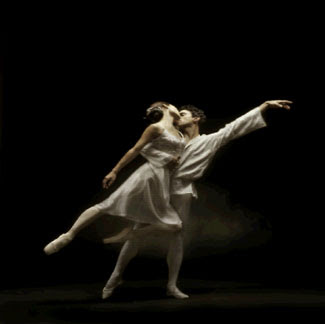
RED REDUX

For Julie Kavanagh

The red strawberry stops between my teeth just before my fingers have a chance to push it further into my mouth. I’m watching Nureyev’s dance of the knight. “O Romeo, Romeo, wherefore art thou Romeo?” Juliet’s dress is kissed with reverence. The strawberry falls between my legs. My eyes are fixed on him. But in my memory I see that his bodily movements are not those in his beloved painting by Fuseli: Satan Starting from the Touch of Ithuriel’s Spear. I’m looking for a dark touch of this illustration for Milton’s Paradise Lost in Nureyev’s Shakespearean Gothic Romanticism. But all is pink. “Pale pink ballet slippers could be yours for just 50 dollars.” They are, according to Christie’s auction catalogue, “considerably soiled and worn.” The Montagues ladies swish their garments against those of the Capulets. Legs go left, then right. My hand goes up and down between my thighs. The strawberry resists being found. Viola d’amore picks up Prokofiev’s dramatic tune of “da.” Da-a-a-a. My mouth, still open, articulates: “what am I saying yes to?” Nureyev’s legs open wider. So do Juliet’s. And mine too. We’re all ready for the red touch. Re-speared. Re-souled. Re-soiled. Re-sealed. Sold.