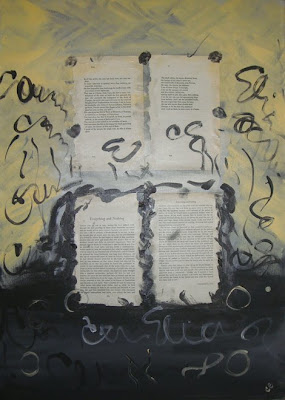
For Reb Derrida
The Foot Fetishists pay me compliments, just as I’m being swept away by the Fastitocalon. “I see you not, because you won’t let me,” I yell in high F. Xes come out of his mouth. “Is your love as white as a foaming sea?” I ask. The floater on ocean streams gives me the rainbow look, but I see him not. “Is your desire a statutory epiphany?” I cry for an answer. I’m ready to catch its vanishing point in the infinite. I hear Lyotard dictating: “there is a language without intention that requires not religion but faith.” I dip my pen into the deep ink ocean, and want to write "effigy" about edifying discourses. I misspell the first letter, as “I” writes itself in the flow. The Fastitocalon allows me to break him at “iff,” when I suddenly see him in the context of his ancient history. I glimpse the wisdom of the Aspidochelone. I fall in love with water letters thus and only thus.
"If I were asked which of all the mysteries will forever remain impenetrable I would not hesitate to answer: the obvious." - (Edmond Jabès: The Book of Shares)
Saturday, March 28, 2009
IFF
Tuesday, March 24, 2009
YES
It’s been a while since a five minute talk could make me relate to someone else’s predicament faster than you say chocolate. Vincent referred to domestic dramas today as they manifest themselves through frustration and exasperation. As he suggested, any father would be bound to be at least baffled if his son answered “yes” when asked: “do you want ice-cream or chocolate?” Making a distinction between inclusive disjunction (that which remains true if either or both of its arguments are true) and exclusive disjunction (that which is true if only one, but not both, of its arguments are true, and is false if neither or both are true) Vincent concluded that, logically, whereas he clearly went the exclusive way – intending for his son to pick one of the two things – his son’s affirmative answer to an either/or question suggested inclusiveness. According to Vincent’s logic, his son would have preferred both.
That maybe so, but if you ask me there are other possibilities. For instance, I’m willing to stake a winning bet on the following proposition: what Vincent’s son said yes to is chocolate. Not ice-cream, and not both. How do I know this, one would like to know? By making recourse to precedence. Here’s an example taken also from the private sphere. In my family both my sister and I do what Vincent’s son does all the time, answer yes (or no) to an either/or question. In our convoluted brains, yes always refers to the last word mentioned in the string, not to all, and not to some other things in the middle. Vincent should try it. I can disclose, however, that the practice drives people up the wall, so I won’t recommend it. Especially not when one is past 40.
Now I actually wonder why neither my sister nor myself grew out of it, especially since our mother was also a logician. So logically speaking there is no explanation, unless we want to axiomatize undecidability. (Ok, I can’t resist so here it comes: there is some logic with a finite frame property that is undecidable (“maybe one or the other”). I like Urquhart’s proposition that for any subset X of ω there exists a logic Ax with the finite frame property, such that Ax has the same “degree of unsolvability as X.” Basically this means that if one answers an either/or question with a yes, no, or even a maybe - which, btw, Vincent anticipates his son might also do one day - one shows a preference for spatial logics that allows for incomplete structures. In other words, one departs from the binary structure of the crossroad (nicely represented on Vincent's chest)).
Finally, however, if I wouldn’t win the bet the logical way, I would still win it because of aesthetics. Choosing chocolate over ice-cream is a sign of good taste – and way exclusive – so to Vincent’s son, I would say this: welcome to the club.
Saturday, March 21, 2009
LOVERS
Today I get up with physics in my head. Later as I try to translate some black holes into pastel colors – I even name my new painting Ergoregion, after Penrose’s process and Kerr space time – I instantly remember Bach’s birthday. Oh my God! How could I forget, I yell at myself, almost drowning the sound of rounded mouths in Bach’s cantatas which I listen to everyday. What to do? I was already finished with the cultivation of energetic mushrooms populating my ergoregion, so I wasn’t in the mood for another painting. But as soon as I blew myself up visually with Glenn Gould on the piano, I decided that I can always squeeze in a small one. Not only was I very efficient – I finished in 10 minutes – but I also managed to read my emails while placing the final touch on the canvas. My own red lipstick from my own red lips got transposed onto it – nothing less would cut it for Bach. A friend of mine, the poet Robert Gibbons, was asking for permission to use a fragment from a review of mine of his work in connection with a new publication of his. He wants these words on the book's jacket:
“Throughout the volume Gibbons dreams of Bach, Bach’s ability to think and create paradoxes and entanglements and he shows that time is affiliated with making variations upon the body. If, as Gibbons contends “the present is the roof of time,” the past—Bach’s time—cannot be anything else other than a variation on illusions. Einstein allegedly said: “people like us, who believe in physics, know that the distinction between past, present and future is only a stubbornly persistent illusion.”
I ended up asking myself whether I was having a cosmic Saturday. Insane people like myself, Glenn, and a host of other Bach enthusiasts would have no doubt about it. Enjoy the music, lovers. It doesn’t come any better. Not ever. Never. Ever.
Thursday, March 19, 2009
CIRCLES
My sister is leaving tomorrow. But only to come back to a whole new life in Denmark in a month. After 20 years of separation, she decided that she wanted to be with me. And Roskilde Hospital has made that possible. They offered her a job beginning in May, so now she wants to go home and quit her life there. As she is in a profound state of happiness she tells me that however practical she may find what the new job has to offer, she insists that what she got from me over the past two months is infinitely more valuable. I asked her: “what’s that?” And she said, “well, a set of threes, of course” referring to my ability to invent slogans, circulate old ones, or simply recognize or stretch bottom lines.
“Keep it simple.”
“When the time is right. . .”
“When the pupil is ready, the master will appear.”
Indeed, such lines were delivered orally either on a daily basis or have been formulated in writing on this very blog, which she reads religiously. I should have been pleased, I thought, yet I had a strange reaction. Clichés coming from her mouth sounded like the beginning of a self-help book. I said to her: “good lord, what happened to your thinking?” And she said: “I don’t need it if I keep it simple. Besides, I can always start thinking again, when the time is right, and if I can’t figure that one out, I’ll always have you to tell me when I’m ready for it.” Touché. Of course, what made the whole situation strange is its circularity. My sister ended up repeating what I myself repeat all the time, not only as an act in itself – repeat the repetition – but also what others have said. Oh, while I gave her a good lecture on the importance of realizing that before she can use ‘my’ lines she needs to really understand what they mean, I couldn’t help envying her innocent and prone enthusiasm - against reflection.
We went up to the Roskilde Dom to get absolution from the sins of repetition and definition, and to say farewell to some favorite ghosts. At my sister’s insistence to immortalize me photographically, I accepted her shooting me once in a circle outside the cathedral and once leaning against a tall tree. Thus standing between the circle and the phallus, I was thinking about how some things never end. Never ever. Not in a circle. Not in a continuum. As Gertrude Stein put it: “definition made a hand.” My sister felt the touch, and so did I.
Tuesday, March 17, 2009
HOT OR NOT
Today I fantasized about picking up the phone and instructing my friend Vincent to drop me an email when he wants to translate things. I didn’t do it though because I hate talking on the phone – there is only one person I ever talk to on the phone with but we have a special reason for that which transcends my general aversion. So emails, yes. On translations and things. Yes. The topic today was new idioms in the Danish language that are produced, or rather invented by immigrants. As immigrants often blend not only their own mother tongues with Danish, but also pepper the new cocktail with loan words from English, one can imagine the hodge-podge. In Denmark, if one wants to experience the making of such new linguistic expressions ad hoc, all one needs to do is parade at the Central Station in Copenhagen. Or wait for coffee in some line, which is what Vincent did when he heard the following pronouncement uttered by a boy of Arabic descent: “Wallah, jeg knepper den burger, eller noget” – (ad literam: "wallah, I fuck that burger, or something.”)
Now, this is all very nice, if only we would not have different possible interpretations of what such an utterance might translate as into 'normal' Danish. For, while Vincent clearly understood one thing, the way he went dissecting the sentence into lexia, I understood another thing all together. Particularly the middle of the sentence posed a challenge. In Vincent’s argument, induced by bafflement, “I fuck that burger, or something” has to do with the man’s hunger. Going via English, and turning the expression into a present progressive tense, he placed an intention where, at least in my opinion, there was none intended. Said Vincent, “if we say ‘I’m fucking, dot, dot, dot, we can make the inference that what the man means to say is this: I’m fucking hungry.” This is the point where I went: huh? I couldn’t follow the argument, as there was no evidence for such an intention whatsoever – to express hunger in the ellipsis – on the part of the one who made the utterance. Speaking grammatically correct, of course, in the sentence, “I’m fucking … hungry”, ‘fucking’ is not even a verb in the progressive tense but a modifier of the adjective ‘hungry,’ the adjective’s predicate.
In my opinion, drawing on cultural implication rather than the literalization of grammar would have given us more precise results on how to take the Arab’s expression. Taken within such a context, the sentence, “jeg knepper den burger” reveals a close proximity to a desire to sexualize the burger. Not only is fucking the burger a metaphor for eating it, or rather ‘showing’ it – the burger, that is – what a man can do to it, but it also functions metonymically. The burger itself stands for a whole range of women whom some men can’t wait to get their fingers in(to) or teeth as the case may be, or whatever. Associatively, following this thought: ‘burger, juicy, yummy, if I’m not gonna lick it, I’m so going to fuck it, man, … or whatever,’ yields a more plausible interpretation than the one offered by Vincent. Even the apposition “eller noget” suggests a way of making complicit the sexualization of things with a counter-effect, namely that of desexualizing things via showing indifference, as a result of possible defeat, as in, ‘the desire is there, but ah, well, you don’t always get it.’, or indifference à la, ‘ah, well, we could just as well do something else.' Here, if the latter is the case, then hunger is definitely not it. If we keep it really simple, then we can also just say that the Arabs in Denmark don't have a nuanced sense of grammar, and for the most part don't know how to use the future tense in Danish. Simply put, the sentence means this: "I'm going to fuck this burger, (... as fast as I fuck a woman) or do something else with it.)
Vincent started with doing statistics on vocabularies. I love it when he sticks to numbers. There I totally lose it, as I’ve never been good at arithmetic. On the other hand, when I think of it, I rather also like it that he takes the plunge into territories that require more boldness.
Monday, March 16, 2009
IN SIGHT
After staring long enough at Rembrandt’s great painting The Jewish Bride, while also reading essays from Gabriel Josipovici’s book Touch, I feel touched in more than one way. I imagine being both of Rembrandt’s models at the same time. The man and the woman. With my hand on the torso I imagine feeling its heat and vibrations. I keep the stroke steady to feel the smoothness, the silky surface, and the flow of the body. With my hand on the other’s hand, I imagine feeling its lines striving for something that is both natural and momentous. There is a complicit doubleness in touch as it confirms its own presence. “Its presence to you, but also its presence to it,” says Josipovici. As I throw myself at plagiarizing Rembrandt, I think of miraculous touches, yet the ones whose healing powers are felt only as a form of longing. I paint as Bach’s Toccata, another form of touch, pounds into my ears. The sounds connect to the orbit of my attention, and I drop some eyes onto the canvas. I want to be tender to them, but I also feel the urge to stick them out of their fixation. But the power of the gaze beyond boundary wins. I close my eyes and feel touched by the eloquence of such (in)sight.
Sunday, March 8, 2009
FAITHFUL FRAGMENTS

Saturday, March 7, 2009
12 TRIBES
So, here it is, the series is complete. As is often the case, however, the real thing looks better in reality. Much better. Those close to me, are welcome to come visit and have a lesson in biblical history. It will not be boring, I promise.
The order is as follows: Asher, Benjamin, Ruben, Levi, Dan, Gad, Judah, Naphtali, Joseph, Zabulun, Issachar, Simeon.
(For those interested in seeing more, go to my webpage here. I extend the invitation for friends to come and see the other paintings as well, before I give them away. I've already started disseminating, so only traces will remain. Related to this, I like what Derrida once said: "When the very first perception of an image is linked to a structure of reproduction, then we are dealing with the realm of phantoms." As I stare at the painting I did today, a collage featuring two poems by Borges, You, I, and a short story, Everything and Nothing, I'm beginning to understand why the Jews had an injunction against the making of iconic representations. For in spectro-poetics the questions who is watching whom and who haunts whom, are always tagged by a demand to respond. But how? Der Spuk des Zitates...)
Thursday, March 5, 2009
MARCH MINDS
For H.D.
At tea with the Mad Hatter, I’m showing him my new painting, Infinity-A-1. “Alice, my dear, you can’t count worth shit,” he tells me. “That’s true,” I concur, and then say, “but I can interpret. Infinity is what it is. Boundless.” The Mad Hatter is thinking about it. He enters in character and says, “yes.” “So, you understand, then?” I ask. “Yes.” My faith is strong but I need more proof. So I ask him again. “What do you understand?” “That infinity is the greater love,” he says. “Good answer,” I say, but then I insist. “If I told you, ‘If I stood on my head for you, what then?” “I would still love you,” he says. “Good answer,” I say again. “If I come or if I go, what then?" “I would still love you,” he says. “If I did nothing and everything at once, what then?” “I would still love you,” he says. The March Hare intervenes: “you 2 are incurable. There is 1 too many ifs in this string of topsy turvys, lovy doveys, and still bills. You both need a seminar in number theory that goes all the way. I’ll teach it, if you want it, and if you don’t, I won’t.” We switch places on the table. 6 riddles fall on the plates. 3 for us and 3 for them. They all sound the same: “What do infinity and form have in common?”
The Mad Hatter: “that we want them only thus.”
The March Hare: “that they are uncountable.”
The Knave of Hearts: “that they are both mature.”
The Queen of Hearts: “that they both murder time.”
The October Einstein: “that they are both relatively relative.”
Alice in Wonderland: “that we remember doing neither.”
Wednesday, March 4, 2009
VOODOO PLANET
Today Vincent has lamented the fast disappearing of good and useful words – albeit of foreign origin – from the Danish vocabulary. Words such as ‘etui’ are now replaced by others whose functions rely on longer and longer descriptions. As he put it, these days when you want to buy one such device to protect your train ticket from dog ears, you have to tell the vendor something along these lines: “I want a plastic thing in which I can put the other thing.” Unless you want to pass as one having just landed from Mercury, that is.
Here I must say that I instantly laughed at Vincent’s bypassing the moon in favor of the other thing, especially since I know that the orbit of Mercury has the highest eccentricity among all the planets in the Solar System. So, for the ones in the know, there was an intended, yet subtle catachrestic and parallel relation to the way in which categorizations are made these days: not the Aristotelian way, but the Platonic one. Unless one knows a thing or two about deconstruction, most people still believe in the one-to-one relation between a thing and a concept. So the function of a thing still reflects whatever most people get to associate with a certain concept.
Since French has become retrograde in spite of its avant-gardism, however moribund these days, it is no wonder that those who insist on not giving up its ghost will be deemed eccentric. Consequently, the fact that the plastic ‘dims’ now replaces ‘etui’ should not be seen so much in the context in which ignorance rules, but in the context in which this ignorance is the result of a cultural crisis which can be traced all the way from the central station in Copenhagen to Roskilde University where the French department awaits its inevitable demise. I can still remember my own moments of eccentricity when I mourned the day we buried French at Aalborg University. Thus, in the face of the inevitable, keeping it simple is a way of embracing it, the inevitable, that is.
Culturally, I’m afraid to say that Vincent himself served to show it, that language goes where it wants to go independently of what we may prescribe. While he got his French right (except for the 'chateque' (Fr. charteque; Da. chartek) he didn’t do so well where German is concerned. Vincent, my friend, an ‘etui’ is not also called a ‘føderal’ but a ‘foderal’ (Da.) or ‘futteral’ (Ger.) Ultimately however, who cares really? The woman behind the counter would not have been able to spot that difference either. So we go with that. Distinctions these days are not made across intention but image. I go with that.
While I think of Napapijri’s use of the Norwegian flag on all their Italian clothes, which Vincent wears, I think of final causes. The thing is that whatever the thing is called, right now, as I’m booking my three weeks vacation in Norway, I also make one-to-one associations: in my mind I’m cruising already in the other thing that some decided to call The Planet Voodoo Mercury 1950 coupe. Hair down, sun in it, and eccentricity galore.
Sunday, March 1, 2009
GHOSTS
On my sister's 39th birthday today we decided to greet some ghosts. None was better suited than that of Hamlet. So we went to Kronborg Castle. While going about the rooms we deconstructed cliches about death. In most people's framework of thinking, when death is not considered a desirable subject for discussion in most contexts, having thus been turned into a taboo, then it is ludicrously referred to in terms that border stupidity. For what do people mean when they say that they 'stare death into its eyes' or 'confront its call'? "Oh, my," my sister and I said to ourselves in a unison: "people are soooo courageous. We're impressed." I mean, honestly. Where death is concerned, I want to hear something that we don't already know. All of us. And without exception. Shakespeare made some good attempts. Thank God. He made Hamlet's introspection - based on suspicion following trust and not the other way around - an act of acting, which however led to a kind of knowledge that didn't save him, even if it could. Ah, Shakespeare. He knew a thing or two about silent surges. Turning to my sister, I asked her: "so, what's in the Winter's Tale today? She said: "why, the same question, of course, but with a slight variation: "to be or not to be. . . fat." Well said. If not Hamlet himself, then his fat ghost could relate.