Friday, January 30, 2009

FINITE CHALLENGE - INFINITE LOVE

This post is inspired by two simultaneous thoughts about chance occurrence: one has to do with recognizing that sometimes certain synchronous events are concurrent in a way that one can deem as being almost excessive. The other has to do with a reminiscent thought which puts synchronicity on a continuum line. So what’s up? Lately the concept of infinity has started popping up in all sorts of contexts that are otherwise completely independent of each other. If it’s not friends who make recourse to it in very interesting ways, then, it’s all around you either in the form of books, virtual conversations, or old compulsions that insist on resurfacing.

To give an example: while reading the latest entry on one of my favorite blogs, Good Math, Bad Math, about Georg Cantor’s continuum hypothesis – all about infinity not being singular but in competition with other infinities, depending on how you count on the N, Q, and R sets of numbers – I get a mail from a friend, one of the editors of the Nietzsche Circle who wants me to translate some Cioran for Hyperion. This I tell my sister, and then because I don’t want to separate my body from the sofa, I ask her to bring me the Romanian version of Cioran’s The Book of Delusions (1936). She can’t find it and brings me instead his first On the Hights of Despair. While making a rejecting movement with my hand, I notice a bookmark, so I open the book. Sure enough, the mark falls on the fragment called “The Cult of Infinity.” I instantly get more enthusiastic. As a consequence I throw myself in the midst of the chatter created by the math lovers on Mark Chu-Carroll’s blog. I sign up to Typepad and leave a comment in the form of a citation. Although I know in advance that it’s only going to be the mathematicians with a highly developed sense of aesthetics that will get it, I nevertheless venture into the land of wonders, snatch slot 33, and write this in the comment box:

“Infinity leads to nothing for it is totally provisional. ‘Everything’ is too little when compared to infinity [...] The penchant for form comes from love of finitude, the seduction of boundaries which will never engender metaphysical revelations [...] Let us live in the ecstasy of infinity, let us love that which is boundless, let us destroy forms and institute the only cult without forms: the cult of infinity.” (99-100)

Now this is all very nice, only, when Rainer inquired on how it was going with my translation of Cioran, the ever gracious person that he is, he placed in his mail something which he knew I would rather like to hear: a reference, namely, to Karmen MacKendrick’s book: Immemorial Silence. Well, of course, MacKendrick, who talks about some of my French favorites, Bataille, Blanchot, and others, makes this comment on Jabès’s poetry: “We need the finite, the spoken and the written, in order to reach toward the infinity which may be fatal to us” (52). Well, of course, again, to those who have even remotely entertained the idea of the infinite, the fact that infinity drove the best of them mad, will not come as a surprise. But as there’s only one life we’re gonna live, as far as we know, who cares really about degrees of insanity in the face of the pleasure that one derives from exploring such an interesting topic! So, we go with it. I’ve been thinking about infinity on many levels since I was little, and I’m happy to say that, as far as I know, I don’t know of anyone who is more sane than myself. All right, I know that the Poe specialists, who will identify this situation with all the mad first person narrators in Poe’s short stories who claimed the exact same thing, will issue a warning. But I take my chances. However, enough of this kind of infinity – there are more examples, quite astonishing some of them, but I’ll keep those to myself, which brings me on to the next topic.

The second event entangles subjectivity with a more concrete manifestation of infinity which is not as abstract as Cantor’s, whom by the way, everyone should read. I was reminded over dinner that when I wrote my master’s thesis I always seemed to have been ahead even of the meetings with my supervisor. On our penultimate meeting, when trying to find a date for a last encounter, I said to my supervisor that it could happen on any of the following days. He looked at me with an incredulous look, even though by then he had already learned that when I said Tuesday, then, it was Tuesday for handing in drafts and the like.

I could tell by the way he was gazing at me that he was very eager to grab the opportunity to tell me the following: “listen, if I were you, I wouldn’t make any promises. You know, it’s not that easy to write the final pages in a continuous flow in just a few days.” Upon having uttered what he assumed was dead certain, he gave me a triumphantly complicit smile. Only, he forgot one thing: to count on what a woman has in her bag. So that look only lasted for very brief moment. Alas. For him.

What happened next was something that I now both cherish as a memory, but which, paradoxically, also gives me an ambivalent feeling towards the way in which I perceive myself. This often manifests itself in an outburst formulated thus: “God, I hate my guts.” What I did was to make a gesture of the most ungenerous kind, insofar as it completely took away the man’s pleasure in challenging me. I defied him in a most supreme way. From a performative point of view, I shall never forget the pleasure I felt at seeing his face, now horrified, as he realized what my elegant counter-move consisted of. I felt like a fucking musketeer who ever so passionately and skillfully swerves her sword over the heads of the almighty. I took 33 pages of my thesis from my bag and let all of them flow onto his desk like snow. I said to him: “next time you want to challenge me, give me 3 minutes that would allow me to do some proof-reading.” That was exactly what was missing from my work, which was also the reason why he hadn’t gotten the pages earlier. I can say this now: some people become infinitely smarter on a collision course with synchronicity. They learn to love what is worth loving in others and then in themselves.

Thursday, January 29, 2009

ATTRACTION

This month I went back to Birmingham. Great place, great university. I was invited to do a reading of some of my poems alongside Jan Macmillan, Dick McBride, David Tipton and Jim Burns. I came in last, but as I pointed out to Dick Ellis, who organized the event and made the remark that I was THE woman in his introduction, my being last was merely customary of a long tradition of saving the best for last. So I set myself up pretty highly for the audience which consisted of 200 people (I’m still amazed that so many turned up for a poetry thing, esp. as there was an entrance fee). The expectation was thus accordingly high, if not even higher, but as the custom also is with THE woman, delivering the goods was not that difficult. After my reading, opinions were divided between fabulous, fabulous, and fabulous. There were variations. Some said phenomenal, some said inspiring, some liked the power and some the electricity. On my part, I was pleased with the British style of showing enthusiasm. I can only recommend performing in front of such a crowd.

Before, during, and after the event, there were drinks. Which makes for more interesting conversation. Dick Ellis, David, Jim, and my sister, whom I had invited along, went for dinner afterwards. More drinks. But, for the life of me, I have no idea why I have always managed to out-drink everyone and still come out of it with my reason intact. This is to say that I have en extremely high tolerance for drinking. Now, I don’t mean to suggest that the company was drunk, but judging by the rapidity in the shift in topics, and not to mention the topics themselves, I had some suspicion. For instance, when David disclosed that he has 9 cats, and I went, “my goodness, pets stress me, because, for the life of me, I have no idea why they always want to jump on me as soon as they see me,” Jim contributed this remark, in all earnest, and genuine expression: “but, my dear, we all want to jump on you, so why is that so surprising?” Well, it is for me. Then when I disclosed, upon request, after a game of guessing that I had passed the 40s, David went, “my goodness, you look absolutely fabulous.” Jim muttered: “astonishing,” referring to the looks, not the age; Dick corroborated with an “indeed,” and my sister supplied: “she always does, and always has.” As I was trying to catch everybody’s gazes simultaneously – let’s face it, how many times do you get such remarks from people who think you are both fab and feisty at the same time – I also turned to the second Dick, the organizer, that is, and answered the question he posed to me just before the astonishing moment occurred. The topic was my latest book on gazes and some Lacan. His question was this: “who can understand all that mirror thing?” As this was also formulated as a challenge, followed by: “I bet you can’t produce three coherent sentences on that,” I went lecturing. David, while staring at my breasts for 20 minutes – Dick’s challenge was no challenge, as I was able to produce a hell of a lot more sentences than 3, all extremely clear and coherent, as Jim remarked – went: “by Jove, you’re so, you’re so… “Smart?”, I said, as he was evidently at a loss. “Yeah,” he said, but he meant something else. “Good then,” I continued. And then I said: “David, tell me about your love life.” I’ll stop here, but not before saying that David was a most gracious story teller, that is, until Dick stopped him with these words: “David, don’t be a fool, can’t you see what she is doing, she’s psychoanalyzing the pants off you.’ That, I was, indeed. And who can blame me?

On the plane back to Denmark, I took Dick McBride’s book, The Astonished I, from my bag, and looked at its inscription. I both relished it and marveled at it. It says: “for Camelia, who sounds like an opera.”


Tuesday, January 27, 2009

STARS, SOCKS, AND SOCKETS

When some philosophical thought, however trivial, is entangled with science and theology, my curiosity gets aroused. As Vincent went cosmic today in his 5 minute presentation on what we can know, what we do know, what we don’t know that we may know, and what we presume to know about the existence of God or some other creatures populating the heavens, the moment that I liked the best was the moment when he shifted the attention from our agency - in relation to the production of epistemic orders according to physical rules that we discover or invent quite according to how our heads help us to imagine - to the unknown. Imagine a logician say that it may not be bestowed upon us to know certain things! So who’s the agent here? God? What a beautiful moment, to leave room for the unaccountable, the uncertain, the unseen, the immaterial, and the untouchable. What Vincent is actually suggesting with this move is that conceptualizing alternative worlds begins with what we can imagine (is real). Factually, indeed, as with Feynman, the wisest attitude towards the equation in which fact and gobbledygook are considered is to say that one exists in relation to the other only “as far as we know.”

As I was writing this, a friend of mine, Gray Kochhar-Lindgren, a philosopher of culture who writes about golf and ghosts, sent me a link to an interview in which another friend of mine, a philosopher of religion and culture, Mark C. Taylor, following Blanchot and Jean Luc-Nancy, makes this statement regarding inter-relational knowledge: – let’s just call it that for lack of imagination right now – “what we have in common is that we have nothing in common.” Taylor’s point is that whatever knowledge is disseminated by academics in whatever form, and with whatever degree of certainty – though he advocates for the dissolution of old-fashioned fetishism with peer reviewed articles and the like that no one reads – should enhance people’s ability to pose questions and produce ideas precisely across disciplines, and also along the lines of what is not given unto ourselves to know. Taylor wrote many books in which he tackles the question of faith in relation to both certainty and uncertainty. Now I wonder if Vincent is thinking of the same. As with cosmic vibrations, I sense that someone is following someone else. Faithfully. Some stepping into others’ footprints (material or immaterial, as the case may be) is going on. I wonder what socks Vincent is wearing. Or what socket he is plugged into right now.

Sunday, January 25, 2009

ALEPH 1 TO X


For Sergio

Coming down the slope in a pink sleigh along the tall towers of San Gimignano, I feel like a thing between a ghost buster and a tomb raider. I wet my index finger to feel the direction of the wind. On this side of the road it’s cold. On the other, it’s hot. I let myself slide off the sledge. My forehead hits the snow. A thought spears through my heart: I’m nobody’s problem. I get up and leave. And leave. And leave. In Italy I plug my finger into Cantor’s navel, and feel his vibrations. His gaze lacks pagination. Death knocks. I answer: “What do you want with me?” He says: “To leave it there where you want us to leave it.” The sleigh takes a turn for both ends. In the continuum, ambivalence is an anti-logic dance. I call it Aleph X.

§

Thursday, January 22, 2009

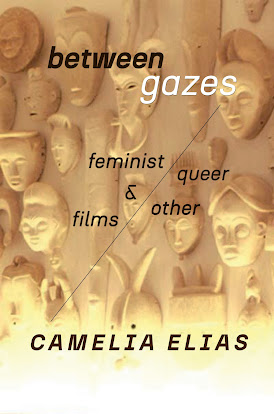
BETWEEN GAZES


Here is my latest academic contribution to the project of enlightenment in the form of outpouring of textbooks.

BETWEEN GAZES: FEMINIST, QUEER AND OTHER FILMS is a text book in which I introduce key terms in feminist, queer, and postcolonial/diaspora film. My point of departure is in the question “what do you want from me?” Although I don't engage Lacan's psychoanalysis in any major depth - he never really addressed anything else in his writings - he snicks in through the back door. Which is good. However, the book analyzes 14 films from different film theory angles in 10 chapters, going tangentially also from the Lacanian theory of the gaze to engaging with emotion and the arts à la Stanley Cavell and Noëll Carroll. The analyses reframe questions of subjectivity and representation in what I hope is an entertaining entanglement of visual with textual poetics in film.

For those in need of details, I can disclose that the word 'fuck' occurs 7 times in the introduction alone. So, there's hope for academic writing.

For those who have been following my latest rantings, yes, I know that I've been threatening to either become a full professor by the end of the year, or retire on top of a mountain. Well, probably neither will happen, but I leave room for entertaining the idea of taking a serious step in either direction. QED

Meanwhile, get the book, have some fun, and learn something. (Ouch, that did sound rather patronizing, didn't it?)

CONTENTS

BETWEEN GAZES
Introduction / 9

HOT OR NOT
Some Like it Hot & Down With Love / 21

CUSTOM COLOR
The Color Purple / 49


FRYING FRANCHISE
Fried Green Tomatoes / 69

CARPE DIEM IN BLACK AND WHITE
Broken Flowers / 89

SAVING SOLANAS
I Shot Andy Warhol / 103

ORLANDO’S STAKE
Orlando / 117

MELLOW MÉLANGE
A Streetcar Named Desire & A Streetcar Named Marge / 135

SHAKE IT SHAKESPEARE
Titus Andronicus & The Merchant of Venice / 149

LAUGHING STOCK
Death in Venice & Boys Don’t Cry / 183

GORGEOUS GEOGRAPHY
East is East / 203

BEYOND GAZES
Epilogue / 219

Friday, January 16, 2009

FAITH


Over dinner, we talk about faith. I yell exasperatedly: “but what does it mean to say that people have faith?” This enunciation alone requires some knowledge; otherwise it is stupid to engage in making it to begin with. But if you have knowledge, by definition you need no faith. Ok, so it was decided over eggs that when faith gets engaged it is because you know you have to make a leap over the first step, which you can imagine is there, but you cannot see. And this is where it gets complicated. Let’s start again: so you can imagine a step. You can imagine it. You can imagine that there is a step you have to make, but you cannot see it, and because you cannot see it, you doubt its existence. So you’re then both a pessimist and one who thinks has faith, but in reality doesn’t. Pessimism and faith don’t go together. Unless you come from Vest Jylland, as my best friend’s father suggests. “Faith is transcendental,” I say. The others are thinking about it. Ok, so we have faith, imagination, doubt, and pessimism. Right. And infinity, I forgot about that. You can imagine all you want. And have faith. I go with this, as a theologian. But as a mathematician? Damn. We need someone who is sharp as a razor in both. Anyone? Horia, the haiduk lektor, knight of my kingdom of stairs, or stares, let’s make it public, we need you to formulate an axiom. If I’m not going to have an axiom by 12 tonight, I’m going to turn into something that’s a hell of a lot worse than a pumpkin. How strong is your theology? Mine is fucking vibrating, but the idea that faith can be imagined ad infinitum gives me the vertigo, so I can’t think straight. But I have faith. I have knowledge of things I don’t know of. Therefore I have faith plus imagination. But is it enough? My faithful mathematicians, do jump at this, make the leap, and sweep my theology off my step! So I can fly over it and kiss the air, with reverence.


Tuesday, January 13, 2009

DEHORTATIO

My friend Vincent is on TV again. Disseminating knowledge. I like the new series, – if I’m allowed to invent: Vincent’s Vivacious Vent – for its bashing style. Rumsfeld’s famous epistemology blunder gets dissected, grand formal style, and in a rapid fashion that it makes my head spin. I hold my eyes fixed on Vincent’s hands. However, the cameraman didn’t do a very good job – he kept cutting most of his fingers thus leaving it up to the imagination to fill in the gaps. Thank God for the split in the sleeve! Now, there was a saving mind line to follow! Straight as an arrow and, very, how shall I put it, well, what do I know? Now, yes, what did Vincent say in the very short five minutes? He anticipated my question, though formulated in a breathless anaphora: “what do I know?” In the face of Rumsfeld’s statement – “there are known knowns; there are things we know we know. We also know there are known unknowns; that is to say we know there are some things we do not know. But there are also unknown unknowns, the ones we don't know we don’t know” – the reflective thought that must befall us is that knowing the “unknown unknowns,” which is a contradiction by assertion, should be valued for its potential to open our minds towards the kind of wisdom that Homer likes to deliver with a lot of dehortatio: “Never say anything, unless you’re sure everyone feels exactly the same way you do.” Jolly good job.

Sunday, January 11, 2009

DESCENT


For Rosalyn Tureck

I watch Eve Sussman’s film. The Rape of the Sabine Women. The banquet. I’m in it - the film. Astrakhan coat in hand. I lament my existence while also lying on the bean bag. Gazing. I imagine being the artist who turns yellow 60s dresses into stone. The Sabines are fighting their fathers. Their brothers. The whole world’s stupidity. It all becomes dust. Sculpted dust. I stick my hand through the silence of the lamb into my pants. The Sabines approve. From the next room I imagine Anonymous descending from my Romeo and Juliet tableau. He’s here. My mind gets filled with desire. We’re going to do the Hockney together. No Velazquez for us. We’re too cosmic for him. The mirrors are good, but the eyes are better. My starship is landed in his.


Eve Sussman's The Rape of the Sabine Women Trailer from creativetime on Vimeo.

Thursday, January 8, 2009

KLEZMER

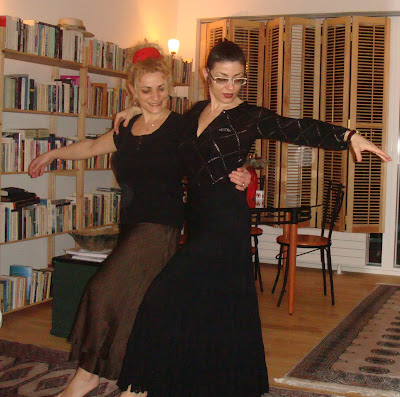
My sister is here. Today, after having gone through the whole Pentateuch with me - oouch - which, unlike me, she knows by heart - I tried to get a word in. I said to her in all earnest, in response to her worry that I don't keep my Bible up: "err, yes, yesterday it was the book of Esther I had a look at." "Good," she said. To escape being further interrogated on what verse I remembered - and it was lucky that it just happened that I could deliver one - I told her that I was sent a CD with some Danish klezmer music to review. "Excellent," she then said, and urged me: "let's slip into the large skirts and dance some." So we did. And we had fun. While I'm no dancer - I can never remember the steps - she is a master. How wonderful to be reminded that counting can be used for something other than how many years one plans on being on this planet, and how many things one wants to do in the meanwhile...


Tuesday, January 6, 2009

INVOCATION


For Quintus Horatius Flaccus

Randolph: “The whole of you, the depth of you, called to me.”
Christabel: “You take me out of myself and give me back — diminished — I am wet eyes — and touched hands — and lips am I too — a very present-famished-fragment of a woman."

I: “If it happens it happens, and if it doesn’t it doesn’t.”
You: “It has to happen.”
I: “And then, you say it will die forever?”
You: “Yes”
I: “Really?”
You: “…”
I: “The eyes, then, can I touch them?”
You: “Yes”
I: “Now?”
You: “Yes”
I: “Then, it happened?”
You: “Yes”
I: “Veni vidi vinci.”
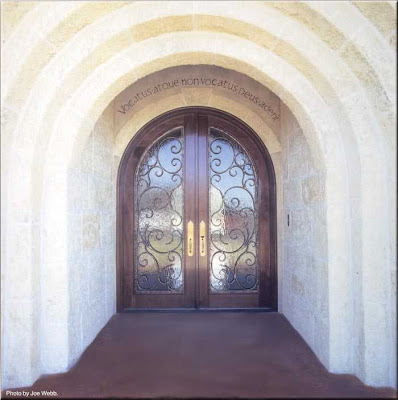
You: “Vocatus atque non vocatus Deus aderit.”
I: “...”

Cecilia Bartoli: “Quella fiamma che m’accende.”

Thursday, January 1, 2009

2009


People have been asking me what I was going to do for New Year’s Eve. Nothing. Absolutely nothing. For those in need of private info and insight into my life, here’s a bit of extreme information. I do nothing. I abhor the very idea of being with others. Always have. I spent my afternoon painting – a photograph with books in it inspired me – and when I finished, I put the canvas out to dry on top of my mirror. The painting came out just right. The picture here doesn’t do it justice. Nor does it do justice to myself – I say this after two glasses of champagne. In spite of wearing nothing other than the silk - no make up, and no jewelries - I thought that I looked pretty stunning. Such knowledge doesn’t require others’ recognition. After the fireworks show outside my new apartment, which was also stunning from both balconies, I went on to reading a book that my best friend and another good one have contributed to. Franca Belarsi gives a stunning reading of Michael McClure’s poem Fuck Ode. So, as I like to fuck traditions myself, here are a couple of lines that should get you all started on your new projects, whatever they may be. You have my good wishes for everything in the new year. Make sure to read some good poems now and then. That’s all I have to say.

FUCKING ON THE CLIFFS ON THE BANKS IN THE BLACK RIVER
in with the fields without proportions, the black clover
grown meadows. THERE IS NO SIZE! Undreaming and vast as a dream. This love is INVENTED. The huge COCK.
Slipping in the soft dream. No dream. In the cunt,
THERE! In the mouth. The slipping of figures upon the other. The rocking, the hugging swaying, HOLDING.

(The emphasis belongs to McClure. I’m not that drunk. Hell, when I come to think of it, I’ve never been drunk in my life. Drunk with emotion and feeling perhaps. But then, as the best of them say: "emotion and feeling behold the highest thought, the very highest thought (Robin Blaser in his talk about the inseparability of poetry and philosophy)).