Thursday, July 31, 2008

RES IPSA LOQUITUR


I’m back in Helsinki. I’m attending the ISSEI conference on Language and the Scientific Imagination. As often, I let myself be inspired by people and talks. But I have quotes on my mind. I see them everywhere. And every time someone quotes a text in a panel, I can’t seem to get past it. My mind wanders off with another quote, which I conjure up in my head and which I imagine I offer in response to the one delivered. I imagine that I elope with my quote. Escape talking things to death. Escape knowing too many things – or is it too few? A motto on the invitation to the National District Attorneys’ Convention in Las Vegas, held between April 25-29, 1971, comes to my mind: “If you don’t know, come to learn… If you know, come to teach”. I’m thinking of middle positions between learning and knowing, between coming and going, between toing and froing. A quote is delivered by a friend: “Those who can't talk, and those who can talk but don't, have the great advantage over the rest of us in that they never say anything stupid. This may be why we are convinced that if they spoke they would have something wise to say.” It occurs to me that science fiction writer Ursula Le Guin is the best philosopher on the concept of non-decision in her book Changing Planes, where these lines are quoted from. Airports of perception. I decide that I don’t want to escape talking, but that I do want to escape knowing – that there might be less or more to love and life and the stuff in between. “That love is all there is, is all we know of love,” Emily Dickinson intimates, also pointing to the fact that the pointless is the point: knowing so little after so much anguish is hardly worth the while. But we often decide not to decide that half way towards knowing we already know that resisting knowing is not a cure for curiosity. “May you live in interesting times,” a Chinese proverb says, and it is not meant as a good omen. At its core there is an implicit valorization of being boring. Asking questions à la Eliot’s Prufrock: “and how should I presume?" Between interesting time and boring time we non-decide to not talk about it.

I go to the library. Bad idea. I stumble over Wendy Cope. Her poetry is all about coping. I pick up her new collection of selected poems Two Cures for Love and even though the book was not part of the Finnish final summer sale, I buy it instantly. I see that my quotes have also been messing with Cope. Eliot’s The Waste Land has been turned into a set of parodic verses. Limericks, to be more precise. The last three verses run like this:

III
The Thames runs, bones rattle, rats creep;
Tiresias fancies a peep –
A typist is laid,
A record is played –
Wei la la. After this it gets deep.

IV
A Phoenician called Phlebas forgot
About birds and his business – the lot,
which is no surprise,
Since he’d met his demise
And been left in the ocean to rot.

V
No water. Dry rocks and dry throats,
Then thunder, a shower of quotes
From the Sanskrit and Dante,
Da. Damyata. Shantih.
I hope you’ll make sense of the notes.”

Res ipsa loquitur. The thing itself speaks. But what is the thing itself?

Wendy’s title poem, Two Cures for Love, has only two lines in it in spite of its obvious significance – but who needs to count, when symmetry gives itself to itself?
“1. Don’t see him. Don’t phone or write a letter."
"2. The easy way: get to know him better.”

Wendy’s book is all about teaching knowing. I wish though that she would say something about the vehicle for illumination. “It's darkest underneath the lampstand,” a Korean proverb says. Watching the half naked Finns promenading down the main esplanda in Helsinki, I have the feeling that they have learned that lesson. How do I know it for sure? I asked.


Sunday, July 27, 2008

MIRRORING WITTGENSTEIN

Today I’ve cleaned the apartment. It’s spotless. Now I wish my sister were still here to see it. Just before she left we had a talking session in the bathroom. In our young days in Romania when we didn’t have much – but the little we had was top notch, and that includes a fantastic bathtub – when I would take a long bath, she would sit on a low stool and recite poetry to me – either from books – I still remember her Lermontov phase and frenzy – or by heart. She can easily recite some 100 verses.

Although I have no bathtub in my new apartment, yesterday we managed to entertain ourselves with something else. I explained to her something about my two Miele machines, which are the apples of my eyes – in another life I’m sure I’m a Miele engineer. Mana, my sister, listened patiently. She knows that I’ve had a fix for Miele more than 20 years now, so she also knows that there’s no way she can stop me once I get started on the benefits of having such things in the house. But as it is with technical things rather than poetry, contemplating engines brings about some other observations than poetical ones. Mana said: “who cleaned your mirror?” “– I did,” I said. “– Like that?” she said, pointing to some hardly visible smudges. “– But…,” I said. “– But me no buts”, she said. “– Either you do a proper job, or forget about it.” Next, I was surprised to see her, a 1970 vintage who measures no more than 155 cm, climbing on top of my sink like a cat to polish my mirror. While cleaning she said: “what we cannot speak about, we must pass over in silence.” Her quoting Wittgenstein baffled me for a second. How could I defend myself, or rather my poor cleaning skills, in the face of such a statement? It was clear that she was going to accept no explanation as to why I obviously didn’t think about getting my mirror to reflect optimally.

I left her to her device – Wittgenstein for mirrors was too much even for me. As I grabbed the door-handle, however, I was reminded of myself 10 years ago, when I wrote my Master’s thesis. After the introduction I had a picture of Wittgenstein’s beautiful design of a door-handle in my text. I used it both as a metonymy for epigraphs and quotes that stand for whole or complete messages – as against hermetic thinking – and as a metaphor for opening (fragment) texts with. Texts opened by fragments.

I left the bathroom and my youth and childhood memories with the distinct feeling that we must be secretly related to Wittgenstein.

When my sister finished she said: “– A penny for your silence on silence.” I offered an idea: “ – It’s elegant,” I said, and I could tell that she was dying to know whether I was making a reference to silence or to Wittgenstein. But it was for her to guess. I went reflecting – on mirroring acts: hers, others, and mine.

Saturday, July 26, 2008

NORMS OF NORMALITY

My sister left again. This is better than it's worse. It's good because I get a break from all the cracking up I've been doing the past three days. As my sister is heavily into farces, it's impossible to have a conversation with her without her making references to hilarious scenes from hilarious books and movies. This she thinks is normal.

The fact that she also thinks it's normal to know by heart the whole film script for The Life of Brian is something that I've gotten accustomed to. Her argument is that since it's normal to live your life according to Monty Python it is also perfectly normal to have their philosophy at hand, lest memory should play a number on her, so she has the whole movie downloaded on her phone.

Her 13 year old son, who is a famous pianist in my home town, thinks it's normal to have a mother who is into quoting films. He does it too. He knows by heart the whole script for Amadeus.

My sister and her son laugh and quote, or quote and laugh. I almost can't tell which is which any more. So it's good they've both gone. I was about to feel utterly inferior in their company. On the other hand, I've noticed that it's very easy to entertain such normal people. I can only recommend looking for signs of normality in one's family.

After a drinking binge at the Carlsberg factories, we went to see a 3-D movie at the Planetarium in Copenhagen. Both my sister and I thought it normal not to ask a kid whether he would like to go, since we wanted to do this ourselves. Later at my office, where I had to pick up a number of new books that I've gotten reissued or published, my nephew gave a piano concerto number in the salon outside my door, and then he told me this: "you know, I absolutely adore you." Now, that I found very normal. But before I got to make a similar statement which would have crowned my nephew Roman style - laurels and everything - my sister intervened and asked her son, imitating Pilate - who can't pronounce the letter R - in The Life of Brian when he interrogates Brian: "are you a Woman?" - No. "Then your father was a Woman."

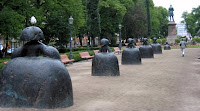
Welcome to the world of normal Womans. Here's a gallery.


Wednesday, July 23, 2008

KINGS' PARKING LOT

My sister is here. We go to see the Roskilde cathedral, and when the lady selling the tickets at the counter tells us that the entrance is free for the citizens of Roskilde my sister cracks up. Of course I know why she does it. Nobody else can figure it out. And since I'm in the know, and I know that what she has in mind is utterly hilarious, I also start cracking up. Very inappropriate given that we are in as close a proximity to where the dead Danish kings have been parked for centuries as one could possibly imagine. Some nuns wearing Mephisto sandals - what the hell, they are heavenly comfortably, they think - look at us in disbelief. I feel sorry for them. They obviously have never seen the scene in Monty Python's The Life of Brian when Pontius Pilate hands Biggus Dickus the scroll to read from after he has failed to pronounce the names starting with R, whom he thinks of releasing: "I shall welease Wodewick" - or Wogew. The crowd cracks up. But Biggus Dickus has an even bigger speech impediment, to the crowd's surprise and delight - his S letters all turn into 'Th' sounds. In Latin rendition, the calling out of names that involve an S sound as Th is bound to create some problems. The crowd cracks up even more. My sister has this scene passing through her head as we pass the sarcophagi: "Thitithenth!" - of Roskilde.

We went through the church with my sister reciting entire chunks from The Life of Brian. She is the only one I know who knows the script by heart - and who also has the whole movie downloaded on her phone. We checked it too for sound effects. The dead were about to rise from their thilentious tombs.

We should have parked our laughter outside - or is it harked, or sharked? I go ask my thithter.

Friday, July 18, 2008

HACKING IT AT CARLSBERG

I’m waiting for my sister to hit Roskilde at the end of the month. She has never been to the Copenhagen area, so I’m trying to make a plan for what to see. She’ll only be here two days, alas. While I go through the tourist sites: Amalienborg, The Round Tower (my favorite), The Little Mermaid (you have to tell people you’ve seen it), Carlsberg. I stop here, as a painful memory intercedes. Almost 20 years ago, I went to visit the Carlsberg factories as part of a sightseeing plan for refugees in need to learn about Danish culture while waiting for their cases to clear for a permanent residence permit. While waiting in the camp, where nothing much happened during the week, such weekend excursions were much appreciated.

After the Carlsberg brewery tour – and back then the ‘tourists’ were a bunch of Palestinians, Somalis, Iraqis, and a few Eastern Europeans – we were shown a slide show featuring the best of a Carlsberg selection of drinks. When the pictorial trip ended, the guide posed a question. She turned to us enthusiastically and said: "so, what was the purpose of showing you this film?" As it turned out, that was a bad idea. There was total silence in the room. The kind of silence that everyone feels is not only embarrassing but also painfully hard to endure. I felt a major frustration building up. I instantly imagined all sorts of scenarios but I could also tell that the answer could not have been that complicated. Yet, however, I was as clueless as the rest.

As far as I was concerned, not being able to answer a simple question was terribly traumatic, as this was something familiar to me. As a child I had a number of moments in my life when I clearly remember that while I was very good at answering complex questions, answering simple questions always caused me a lot of problems. At Carlsberg my own deeply-felt and deeply-rooted frustration was seconded by the guide, who also had to give up and provide an answer herself. In a tone of exasperation she said: “the point of showing you all these drinks was to make you thirsty.” What a revelation! I’m quite sure that a few of the others also felt it was a relief that the quiz didn’t involve anything else. I’m also quite sure that I went, “God, how obvious, and true, and how stupid of me not to be able to make that connection faster.”

To this day, I associate Carlsberg with my unfulfilled desire to become a famous mathematician, who is very good at encrypting codes and that kind of thing. For such Carlsberg moments always make me wonder why as a kid, whenever I had to solve a problem, I would take so long to think about tiny and insignificant little words or letters that would populate my pages and equations at the expense of just getting on with it. I would often go, “oh, look at this X, how pretty, and how symmetrical in its leg arrangement, and look at the point of its convergence, how perfect”; and then I would wonder for ages if convergence meant anything, and whether it had anything to do with the effect of the X in terms of suggesting a graphic repetition of its axes, as it were, not to mention that X and Ax almost sound alike, and why Y - which also superimposes sounds (Y over Y, why over Y, and vice versa) - while having a converging point in the middle, would also have its point create an optical illusion, so that the point of the Y would be, if not besides then above the point, and so on. You get the picture. Such philosophical inclination usually ended up putting my arithmetical skill off its track.

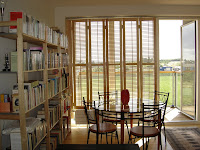
My sister will want to keep her Copenhagen and Roskilde memories. She is one of the few people I know who is able to reproduce everything she reads and sees almost ad literam. It’s lucky that she only reads what she has to. I, on the contrary spend a lot of time reading all the time – all sorts of things, and from all sorts of angles. Yet I can safely also say that I remember very little of everything afterwards. I have a synthesizing reading ability, which is very intense in its thrust. Interconnecting ideas are superimposed in a palimpsest that spreads horizontally on a plane, and I have discovered over the years that if there’s anything that keeps it all together, then it’s certainly not memory. It’s more of a gut feeling that makes me navigate from word to word without thinking that punctuation, which marks gaps in texts, is there for a reason. In my reading experience there are never any gaps of any sorts. Words float and are often 3 inches above the page ground. And yet again, while writing this, words get fixed on hammering an idea that counts – here both meanings are intended. Thus, now, instead of enumerating tourist sites, I count how many slates there are in my newly acquired, and insanely beautiful, colonial style wood shutters. The sun streams in, and it hammers my iron with laser-like rays rather than an ax. Symmetry on the floor created by high tech energy. Oh, so many Xes. Fe--nomenal. No wonder I never made it as a hacker. I’m too busy agonizing.


Wednesday, July 16, 2008

MORE FRAGMENTS

This is a note for all those that read everything I write. Yes, yes, I have to be more serious. So, seriously, then, since there is this wordpress craze, I've decided to create another blog, befittingly titled: MORE FRAGMENTS, which in effect is a repetition of the title of my tumbler quotes, also called More Fragments.

So, what I'm saying is this: there's a new blog in town called: MORE FRAGMENTS. I'll post there snippets of book reviews for academic journals. The reviews that I write are often commissioned – well, some people just love it when I go bashing styles around...

So keep an eye on it if you're interested in knowing what I think of other books, or what books I find interesting to write about.

The next post, due in a week, is going to be a review of Robert Baker's The Extravagant. It will be my last academic contribution to a solid journal this summer (and for that matter to a solid blog, my own, if I must say it myself, or should I use Norman Holland’s words in response to my Frag/ments blog: “what a supremely literate blog” – thanks Norm).


In other words, I have other fragments to fry while on top of my beloved mountain in Norway this summer. These fragments will annul a tight deadline with the hardcore theoria poesis praxis scholars in Averio that are publishing my monograph on Lynn Emanuel. For good measure, keep an eye on that too if you’re into poetry and philosophy. My manuscript goes into print September 1.

Have a great summer everyone.

Camelia

(p.s. yes, yes Steen, I know that you think that I should make a clean switch to wordpress from blogger, but, what can I say, I'm old-fashioned, I kinda like my old blog... See you in Finland in a few days – gosh, with all those intellectual history philosophers. Ouch... it's good we'll have the sauna to get hot on).

Tuesday, July 15, 2008

THE HITCHHIKER'S FORD TO IKEA


We go to IKEA, my husband and I, to get a thing that only IKEA has. The trip is always an event. Especially since I use the opportunity to exercise one of my most perverse indulgences: watching people, really up close. There is often a ritual involved. As my husband knows that watching people entertains me a great deal, and as he knows that such an activity usually elicits a hilarious comment or recalls an even more hilarious quote, we have an understanding as to what we want to do for 20 minutes apart from shopping, eating, and going to the bathrooms.

We take a quick look to see what the most populated isle is: this time it seems everybody is rushing to get a dresser, so we take our flat cart, install ourselves comfortably on borrowed cushions and start watching. As people file by in front of us we go from: “oh my god” to “that’s not too bad” where bodies, screaming babies, and bad fashion are concerned. At the end of the affair, indeed, the anticipated word of wisdom comes. I tell my husband in a very serious tone: “the meaning of life is 42.” We laugh like crazies, people get to watch in turn, and I don’t mind that they are envious at our sudden outburst.

What I secretly wish for them is that they had read Douglas Adams’s: The More than Complete Hitchhiker’s Guide – although it’s not sure that they would relate to Adams’s numerical response to one of life’s most intriguing philosophical questions. But it’s really very simple. We go through life counting: one two three four ("pick it up, two three four," says another marching crowd, the elephants in Disney’s animated Jungle book). Indeed.

In the introduction to his guide, says Adams: “I went to Cambridge. I took a number of baths – and a degree in English. I worried a lot about girls and what had happened to my bike.” And so it goes. Completely linearly. First it was this, then it was that, and then a third reason for this or that. Arthur’s companion in the book, Ford Prefect, is always under a lot of stress. He always has to explain that the world is going to end in less than 2 minutes, also suggesting that this has to do with the fact that everyone had become really stupid. One of the people, a barman Ford talks to, serves as an example. Says the barman: “I thought that if the world was going to end we were meant to lie down or put a paper over our head, or something.” “If you like, yes”, says Ford. And so it goes. Perfect communication on doomsday cannot be ensured, not even when hit by a Ford 2 minutes before the second and last thing happens.

I tell my husband: “my dear, we have to keep up with the Joneses. We must buy a dresser.” We did. Now we have two of them. Then we each have 15 Swedish meatballs, because they are down from 55 to 45 kr. IKEA’s 50th birthday in Denmark is being anticipated.

We eat our food, and bury ourselves completely in the magazines lying around. We say nothing to each other. I, in my thoughts, he, in his; I, thinking of how many screws we have to screw (in) before the end of the world; he, thinking of giving me one penny for my screwy thoughts. I adore the silence between us. It creates many beautiful imaginary images. These, complemented by the live ones we’ve just experienced, make me think that, sometimes, being so close to people that you can almost touch them and their thoughts in one beat beats imagination. Not however the meaning of life – if that is not 42, then it certainly is some other number. We cannot (af)Ford to believe anything else.

Tuesday, July 8, 2008

STAR(R)ING FORTUNA


After attending the Literature and Psychology conference in Lisbon, and meeting a whole bunch of renowned psychoanalysts, the creative vibe is high. Here is a tableau. My husband and I are sitting at our kitchen table enjoying our morning coffee. Dressed in a silk brocade robe that I gave him years ago, and exuding a strong sensuality as he peels a grapefruit for me – the way he always does in the morning – recalls for me one of Boccaccio’s drawings called Lady Fortune from an edition of his De Casibus Virorum Illustrium (On the Fates of Famous Men). I praise my luck. What we have between us is an understanding that is based on combining style with trust in each other’s aesthetic intelligence. I tell him that I’m considering going into practicing psychoanalysis. He tells me that I suffer from analyst envy. He is right. Of the two of us, he is the better Freudian. I tend to go with Lacan, for whom every act of memory is an act of desirous and disastrous imagination.

The last session at the conference, which was a celebration of Norman Holland’s work, was quite a feast. Illustrious scholars such as Murray Schwartz, an intriguing and fascinating Shakespearian, and Jeffrey Berman, author of Risky Writing and promoter of the pedagogy of self-disclosure in the classroom, did a good job at entangling psychoanalysis, creative writing, autobiography, and academic writing that guides itself according to the principles of know thyself – also the title of Murray and Norm’s latest
collection of essays. Norm responded in kind, yet his call for seeing an identity theme (one of his major concepts) shape itself through style in literature was almost at odds with itself. Norm has always been a believer in unity, but as far as style goes, for me at least, it’s all about construction. Style as the reduction of unity to fragments, to the bare essentials scattered in the frame of different contexts, clashes with the rather essentialist notion that texts exhibit an identity theme which we can uncover and which makes us wiser about an author. As the audience responded mainly by bringing in Heinz Lichtenstein's work, esp. The Dilemma of Human Identity, all I could think about was Georg Lichtenberg’s aphorisms that take issue with the dilemma of human style. Following the good old psychoanalytic tradition of free association – one Licht was replaced by another Licht – I offered at the reception one of my favorite Lichtenberg quotes from his The Waste Books: “three smart remarks and a lie make a writer”. It was a good contribution.

Back at home, looking at my husband and trying to guess not only what he has in mind, but also what his affect lets me read into, I’m thinking about style as it relates to our being in the world. Mind-games are language-games. Wittgenstein knew all about it. I’m particularly attracted to his idea that it is not the certainty of propositions that we have to trust, but the way in which others respond to our agency. I’m leafing through Gabriel Josipovici’s book On Trust, and I read these lines: “suspicion has to follow trust, not precede it […] to begin with suspicion is to condemn ourselves to solipsism” (274). His book ends with a famous quote from Eliot: “last year’s words belong to last year’s language and next year’s words await another voice”. Until next year’s conference, I think I’ll let my husband cure me of my analyst envy by following Wittgenstein’s introspection: “If I don’t trust myself here, why should I trust anyone else’s judgment? Is there a why? Must I not begin to trust somewhere? That is to say: somewhere I must begin with not-doubting; and that is not, so to speak, hasty but excusable; it is part of judging” (On Certainty, 150). Indeed “it is our acting which lies at the bottom of the language-game” (204). I let my language go on holiday. I reserve my seeing to the appreciation of silk, art, and fortune.

Monday, July 7, 2008

IF I EVER


For Tiresias

“Stop reading signs. Sense them,” he tells me. “Stop reading altogether,” he furthermore says. I’m happy to oblige. I’ve just been on the phone with Georg Cantor and he told me the same thing. I presented Cantor with a line from Shakespeare’s King Lear: “never, never, never, never, never”. Shakespeare knew his Sophocles. Cantor didn’t. Cantor knew set theory, but Tiresias beat him to it. “Infinity is a question of trust,” I imagine Cantor saying. I believe him. There is a reason why Lear said what he said five times. Tiresias prophesized twice as a woman, twice as a man, and once as a sex god for good measure. Blindness is knowledge that can’t tolerate one’s knowing that one sees. Nothing converges with never. Not even when we insist five times. I vacillate between the trivial and the momentous. The Greek choir that numbers the fabulous five: Cantor, Lear, Tiresias, Shakespeare, and Sophocles, urges me on: “forget about the whole thing, but don't forget us.” I nod. Everything is possible in the infinite. No chaste divas are allowed there. Only fractions. And fractals. And fragments.

Saturday, July 5, 2008

TRANSGRESSIVE ACTS EXQUISITE FACTS

One of the best things about the conference on Literature and Psychology, held annually in different European cities, and which I have attended with faithful regularity for some years now, is the fact that it enforces two things for me. First: Freud still comes across as fresh and exquisitely brilliant as ever especially in respect of his concept of the death-drive formulated in his fabulous essay: “Beyond the Pleasure Principle.” Second, yes, Lacan is still a good read before bed (well, Plato used to think that one should read some math before bed to avoid what he called illegal thoughts, but I find that idea ludicrous especially in light of the innocent question, what’s wrong with having erotic dreams?)

But apart from having some personal opinions and positions consolidated or relishing the opportunity to meet some of the best Freud and Lacan interpreters around, the conference always manages to put some things in perspective for the scholar who, after a whole term of teaching ‘down to earth’ stuff, gets to reflect on the meaning and implication of creative activities.

What I’ve just realized today, while listening to Nancy Blake’s talk on Ian McEwan, is that the best literature around is the literature that tests the limits of language by making recourse to testing the limits of its protagonists and readers alike – as if when asking the question: if a writer makes his characters do unbelievably bold things, but things we can believe in nonetheless, how are we going to handle it? (Off the top of my head I hurry to suggest here: make sure you enjoy being in a state of astonishment, rather than run away, close the book, and curse the author). Nancy, who is one of the best Lacanian ‘translators’, suggested that while the main female character in the story becomes a successful violinist, even though only through sublimation, she fails as an agent in her other relations that involve the consolidation of her subjectivity because she is unable to pose the most important question at last: what has the price for creativity been?

Anne-Maria Mazzega-Bachelet later suggested that all good literature (her example was Kafka) goes through 4 movements in relation to the way in which it depicts the trauma that a creative act necessarily involves: intensity, sexual content, nonsense and silence, and repetition. On this list I particularly like the last two: when the author establishes intensity by reference to sexual symbolism, 'nonsense' takes over and articulates itself forcefully which necessarily brings forth silence: characters and readers alike are baffled, so they 'say' nothing. Because silence is instituted, there is thus a need for the repetition of all the other movements. This repetition is what constitutes transgression. While this transgression often comes close to being interpreted as a form of obsession, it also ensures that something interesting happens between the author of the stories, the protagonists in the story and the readers of the story.

The brilliant insight is that because transgression is what it is, a site of struggle and tension with language and ideas, it cannot per se also be the vehicle for communication as a result of precise readings (across and between the agents involved). In other words, everybody misreads everybody else – but not entirely. An author may estimate a reader’s response quite accurately, but not because she is able to read her opponents (characters and readers alike) with infallible precision, but because there is always a chance that she is wrong precisely and inasmuch as she is also right. I like this idea, especially as it relates to an ethical question: how much responsibility do writers have to show to their readers (the sources of inspirations are included)? Here the correct answer must be this one: none, if creativity is to stand a chance of survival in its intense, ravishing, illuminating, and for the most part violent mode. Words are bodies, poststructuralists such as Judith Butler have taught us: they can be hurled at others; they can be made to caress others; they can be served as dishes for others to swallow, enjoy, or vomit (as Avital Ronell also put it); they can be made to transgress others’ limits of being in the world by enhancing their eloquence, craft, articulation, calculation, communication, and creativity.

I’m going home soon with this lesson in mind, which brings forth a self-imposed and self-enforced imperative: if you want to keep writing, keep doing what you’re doing, read some Lacan for good measure before sleep or sex, and dream of dying with some damned good book in your hand.

Wednesday, July 2, 2008

BIFURCATION THEORY


For Alex Nicolin

“In physics a horseshoe is more than a symbol for luck; it’s a matter of trust,” I tell him. Bohr didn’t believe that luck stepped in in flat iron heels, but he believed the person who said to him that whether he believed it or not, it was true. This is what I would call a ratio of convergence, though Feigenbaum might disagree. “Are you going to hang out with the nerds again,” he wants to know. He heard me mumbling to myself: “epsilon over square root of gamma,” “X is in the rescaled deviation from the equilibrium width.” “Yes,” “I need to calculate precisely how much I’m going to excite the first resonance.” He knows that this is what I do when I go in the negative: no understanding, no knowledge, no vision, no priming of the reader, no spreading of atomic legs, no horseshit, no certain energies, no bouncing. I apply some Bohrian psychoanalysis to myself: g forces, horses and spots set the shape of the function of narrative. Bohr is exasperated: you’re mixing the gs with the qs again. Stick with Gauss. But I’m already in a Bose trance. Condensed thinking is cold thinking. I lose my individual identity. My blob coalesces with exotic geometries. No one understands a thing, but it is beautiful. Blip.